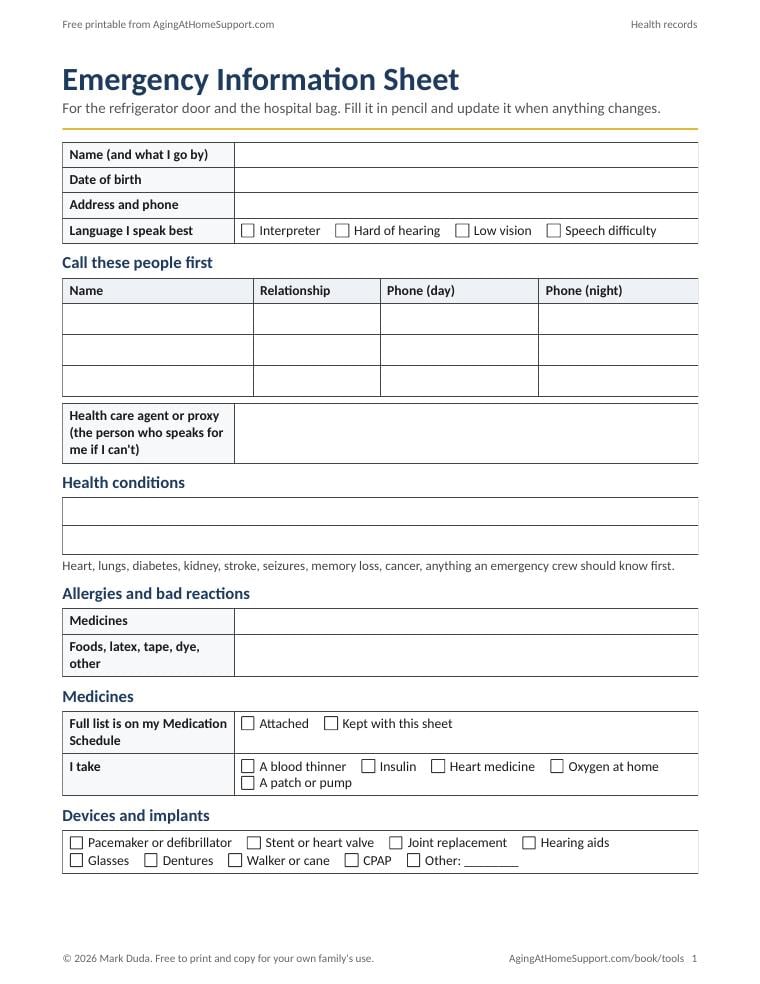
An emergency information sheet puts a senior’s conditions, allergies, medicines and emergency contacts on one page, where a paramedic, a neighbor or a hospital nurse can find it. This free printable emergency information sheet is two pages, with a wallet card to cut out. The first questions a crew asks are about medicines, allergies and who to call. At 2 a.m., few people can answer them from memory.
The short version
- Fill it in once, in pencil, and post it on the refrigerator door at eye level.
- Put on it what a crew needs: conditions, allergies, medicines, devices, contacts, doctors and wishes.
- Leave off what a stranger could misuse: Social Security, full insurance and bank numbers, and door codes.
- A living will is not a medical order. According to CaringInfo, EMTs cannot honor an advance directive or a medical power of attorney, but they must honor a POLST.
- Update it after every hospital stay and medicine change, and at least twice a year.
Download it free
2 pages, ready to print on standard letter paper. The second page has a wallet card to cut out.
Download the PDF →Free. No email required.
Know someone who needs this?
Pass it along — it’s free, and it might be exactly what a family you know is searching for right now.
What’s on it
- Name, birth date, address, and the language spoken best, with boxes for hearing, vision and speech difficulty
- Three emergency contacts with day and night numbers, and the health care agent who speaks for your parent if they can’t
- Health conditions and allergies, including medicine, food, latex and tape reactions
- Quick flags for blood thinners, insulin, heart medicine, oxygen and patches or pumps, with a pointer to the full Medication Schedule
- Devices and implants: pacemaker, stent, joint replacement, hearing aids, glasses, dentures, walker, CPAP
- Doctors, pharmacy, insurance plan names and preferred hospital
- Which advance directive paperwork exists, and where the originals and copies are
- Who lives in the home, pets, who holds a spare key, and what helps if your parent is confused or scared
- A cut-out wallet card with the essentials
What to leave off the sheet
The refrigerator door is public. Every visitor, delivery driver and contractor who comes into the kitchen can read it. That is why the sheet asks for the name of the insurance plan, not the number, and has a line that says where the cards are kept. Leave off Social Security numbers, bank details, door and lockbox codes, and passwords. Tell the people who need the codes instead.
The trade-off is real. A sheet with fewer details is less useful to a crew, and a sheet with more is a risk if it is read by the wrong person. The middle path is what is on the page: everything a responder needs to treat, and nothing a thief needs to impersonate.
Where to keep it so it gets found
The refrigerator door is the usual place because crews and neighbors know to look there, and it is where a parent already goes every day. Beyond that:
- A copy in the hospital bag or by the front door, with the medication list
- A photo of the sheet on the phones of the people who would be called first
- The wallet card in a purse or wallet, folded around the insurance cards
- A copy handed to the crew, if there is time, and carried to the hospital
No system guarantees that a crew will see the refrigerator. That is why the wallet card and the phone photos are on the list. If your parent wears a medical ID bracelet, this sheet backs it up. It doesn’t replace it.
Advance directive, DNR order or POLST: which one a crew can follow
Families often assume the living will in the drawer will be followed in an emergency. According to CaringInfo (a program of the National Alliance for Care at Home), EMTs cannot honor advance directives or medical powers of attorney, because those documents name who speaks for a person and what they want. A POLST is different. It is a set of medical orders signed by a doctor, and CaringInfo says EMTs must honor it.
CaringInfo also says a POLST is meant for people who are seriously ill or very frail. For a healthy older adult, an advance directive is generally the right tool. Form names vary by state: POLST, MOLST, a DNR order. The sheet has a box for each, and a line for where the originals are. Ask the doctor which applies to your parent, and see living will vs. power of attorney for how the documents differ.
If your parent has memory loss
The last row on page two, What helps if I’m confused or scared, matters more than it looks. People with dementia may not be able to answer a crew’s questions, and may be frightened by strangers and noise. Write what actually works: the name they answer to, a person whose voice calms them, whether they tend to hide pain, and whether they might resist being touched. Specifics like “will say she is fine when she is not” help a crew more than a diagnosis does.
Questions families ask
What should be on an emergency information sheet for seniors?
An emergency information sheet for seniors should list the person’s name and birth date, emergency contacts, health conditions, allergies, current medicines, doctors and pharmacy, insurance plan names, and where the advance directive paperwork is kept. It should also say who lives in the home and anything that helps if the person is confused. This printable has a place for each of these on two pages.
Where should I put an emergency information sheet?
Put it on the refrigerator door at eye level, with a copy in the hospital bag and a photo on the phones of the people who would be called first. Add a wallet card as a backup. No placement guarantees that a crew will see it, so use more than one.
Should I put a Medicare or Social Security number on it?
No. Write the name of the insurance plan and note where the cards are kept, and leave Social Security, bank and policy numbers off. The sheet hangs where visitors and workers can read it, and the numbers are on the cards in the wallet if a hospital needs them.
Does a living will work in an emergency?
Usually not on its own. According to CaringInfo, EMTs cannot honor advance directives or medical powers of attorney, but they must honor a POLST, which is a signed medical order for people who are seriously ill or very frail. Ask the doctor which paperwork applies in your state.
How often should the sheet be updated?
Update it after every hospital stay, every medicine change and every change of doctor or emergency contact, and at least twice a year even if nothing seems to have changed. An out-of-date sheet can be worse than none, because a crew will trust it.
Is this sheet a legal document?
No. It is a summary for responders and family. It does not appoint anyone to make decisions and it does not record a legal wish. Advance directives and medical orders are separate documents that need a signature, and in some cases a doctor’s.
Pair it with
- Medication Schedule — the full medicine list this sheet points to
- Important Documents Checklist — which papers exist and where the originals are
- Living Will vs. Power of Attorney — what each document does
- Home Safety Walk-Through — the room-by-room check
- All the printable tools from the book
Changelog
- 6 November 2026 — Published. Added the free Emergency Information Sheet printable.
This page is reviewed every six months, or when the guidance it draws on changes. When it changes, this list will say so.
Sources
- CaringInfo, “POLSTs Are Portable Medical Orders” — what a POLST is, who it is for, and what EMTs can and cannot honor. CaringInfo is a program of the National Alliance for Care at Home.
- National Institute on Aging, “Safe Use of Medicines for Older Adults” — keeping one list of all medicines, with a copy at home and one in the wallet
Last verified: 6 November 2026 against CaringInfo guidance on portable medical orders and NIA guidance on medicine lists · Next review: May 2027, or when the guidance changes
This page is educational and is not medical or legal advice. Mark Duda is not a physician, nurse, pharmacist or attorney. The sheet is a summary for responders and family and is not a legal document. Ask your parent’s doctor which medical orders apply in your state.