A medication schedule lists every medicine a person takes, what each one is for and what time of day it is taken, on one page the whole family can read. This free printable medication schedule is three pages: the master list, a page for as-needed and over-the-counter products, and a weekly check-off chart for a pill organizer. When a parent takes eight or nine pills at four times of day, the pharmacy labels are nine separate instructions, not a schedule.
The short version
- One row per medicine. Copy the name and strength from the pharmacy label, then tick the times of day it is taken.
- Page two catches what labels miss: as-needed medicines, over-the-counter products, supplements, and medicines that were stopped.
- The National Institute on Aging advises a list of every medicine, including over-the-counter and supplements, with the amount, times, prescriber and reason, and one copy at home and one in the wallet.
- Ask the pharmacist for a review with every bottle in a bag. The questions are on page two.
- Don’t change a dose from the chart. It records what the prescriber said. It doesn’t decide.
Download it free
3 pages, ready to print on standard letter paper. Page three is a weekly check-off chart you can copy for each week.
Download the PDF →Free. No email required.
Know someone who needs this?
Pass it along — it’s free, and it might be exactly what a family you know is searching for right now.
What’s on it
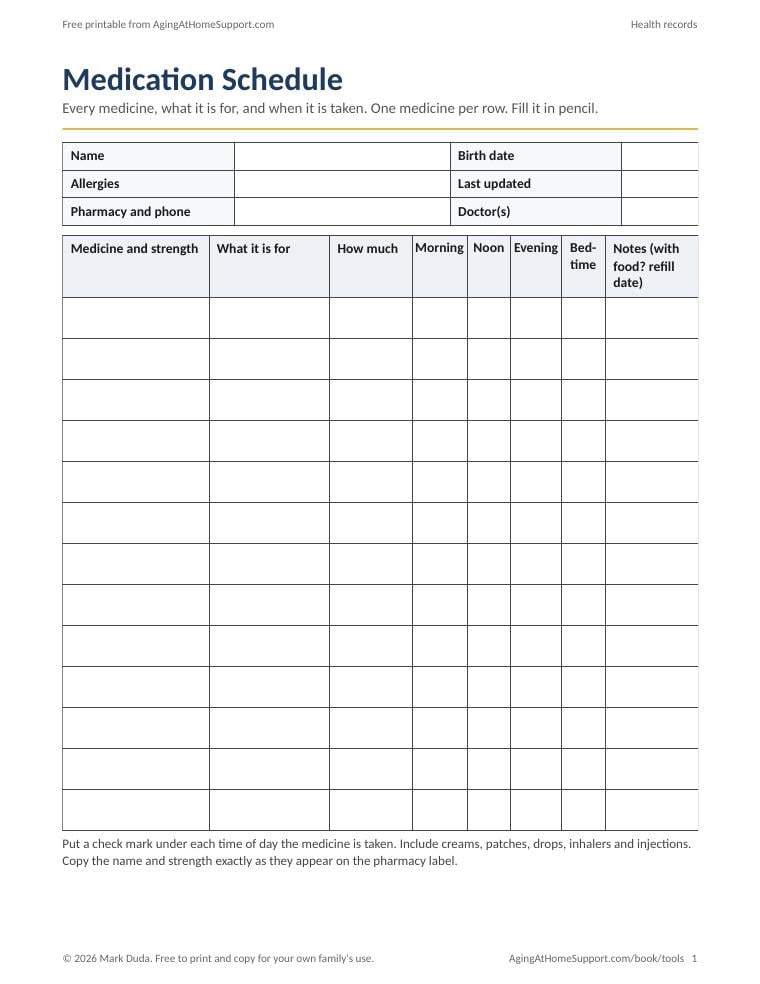
- Page 1: the master schedule, with 13 rows for medicine and strength, what it is for, how much, a tick box for morning, noon, evening and bedtime, and notes on food and refill dates
- Page 2: a table for as-needed medicines, over-the-counter products and supplements, a “stopped medicines” table, and eight questions for the pharmacist
- Page 3: a weekly check-off chart, Monday to Sunday, for each time of day, with space for missed or changed doses
- Name, birth date, allergies, pharmacy and doctors at the top of page one
How to fill it in
- Gather every bottle, patch, inhaler, cream, eye drop and supplement in the house, including the ones in the bathroom and by the bed.
- Copy each name and strength exactly as the pharmacy label shows it. “Metoprolol 25 mg” and “metoprolol 50 mg” are different rows.
- Write what each one is for. If neither of you knows, that is the first question for the pharmacist.
- Tick the times of day. Add a note if it must be taken with food, on an empty stomach, or on certain days.
- On page two, list the as-needed, over-the-counter and supplement products, and the most that may be taken in a day.
- Give a copy to the doctor and the pharmacist, keep one in the wallet, and photograph it for the family’s phones.
Why the “stopped medicines” box matters
After a hospital stay or a change of doctor, the old bottles stay in the cabinet. A parent with a fading memory, or a helpful relative, can restart a medicine that was stopped for a reason. The table on page two has room for the name, the date, why it was stopped and who said so. When you bring a parent home from the hospital, check it against the discharge papers. The questions for the discharge planner include which medicines are new, changed or stopped.
Using the weekly chart with a pill organizer
Pick one day a week to fill the organizer, and write the date and who filled it at the top of page three. Write the medicines due at each time in the wide column and tick each day as the dose is taken. The chart doesn’t replace the organizer. It shows, at a glance, whether Tuesday’s evening dose was taken, which is the question a care partner asks by phone. If doses are being missed, tell the doctor or pharmacist about the pattern. Don’t skip, double or stop a medicine on your own.
A ten-minute pharmacist review
Put every medicine, patch and supplement in a bag, take it to the pharmacy, and ask for a full review. Page two has eight questions to tick off, including whether each medicine is still needed, whether any interact, and whether any could cause dizziness, confusion or falls. The last one matters for aging at home: a medicine review is one of the first steps in preventing falls, and it is the step families most often skip. The National Institute on Aging also suggests using one pharmacy where possible, so that the records stay together.
Questions families ask
What should a medication schedule for seniors include?
A medication schedule for seniors should list each medicine’s name and strength, what it is for, how much is taken, and the times of day, with notes on food and refills. It should also include over-the-counter products and supplements, medicines taken only as needed, and the person’s allergies, doctors and pharmacy. This printable has a place for all of these.
How do I make a medication schedule for my elderly parent?
Gather every medicine in the house, copy each name and strength from its label, write what each is for, and tick the times of day it is taken. Then add the over-the-counter products and supplements, and check the finished list with the pharmacist. Print the three pages, fill them in pencil, and update them after every medicine change.
Should over-the-counter drugs and supplements be on the list?
Yes. The National Institute on Aging advises listing every medicine, including over-the-counter drugs and supplements, because many interact with prescriptions. Page two of this printable has a table for them, with a column for the most that can be taken in a day.
How often should I update a medication list?
Update it every time a medicine is started, stopped or changed, after every hospital stay, and at least twice a year. A list that is out of date can lead a doctor or a crew to the wrong conclusion, so replace old copies in the wallet and in the hospital bag.
Who should have a copy of the medication schedule?
The doctor, the pharmacist, the family member who fills the pill organizer, and your parent, in a wallet or purse. Keep one with the emergency information sheet and in the hospital bag. The National Institute on Aging suggests one copy at home and one in the wallet or purse.
Can a medication schedule replace a pill organizer?
No. The schedule is the record of what should be taken and when, and the organizer holds the pills. Use the weekly chart to check each dose off, and fill the organizer from the schedule once a week.
Pair it with
- Emergency Information Sheet — the one-page summary that points to this schedule
- Questions for the Discharge Planner — including which medicines changed
- Letter to the Doctor and Appointment Prep Sheet — bring the schedule to the visit
- Fall Prevention for Seniors — why a medicine review comes first
- All the printable tools from the book
Changelog
- 6 November 2026 — Published. Added the free Medication Schedule printable.
This page is reviewed every six months, or when the guidance it draws on changes. When it changes, this list will say so.
Sources
- National Institute on Aging, “Safe Use of Medicines for Older Adults” (archived copy read) — keeping a list of every medicine with the amount, times, prescriber and reason, one copy at home and one in the wallet, and using one pharmacy where possible
Last verified: 6 November 2026 against National Institute on Aging guidance on medicine lists · Next review: May 2027, or when the guidance changes
This page is educational and is not medical advice. Mark Duda is not a physician, nurse, pharmacist or attorney. Do not start, stop, skip or change any medicine or dose without asking the prescriber or pharmacist. The chart records what the prescriber has said, and does not replace it.