A blood pressure log turns a month of home blood pressure readings into something a doctor can use. This free printable blood pressure log is three pages: a guide to taking a reliable reading, then a month of morning and evening entries with room for pulse and notes. A single office reading is one moment. A month of home readings shows the pattern.
The short version
- Sit quietly for five minutes first, with the back supported, feet flat and the arm resting at heart level.
- Write the numbers down exactly as shown. Don’t round them or keep only the better reading.
- Ask the doctor for the goal and write it at the top. The category table is general. The target is individual.
- Over 180/120 with chest pain, trouble breathing, numbness, weakness, vision change or trouble speaking: call 911.
- Low readings matter too, especially with dizziness on standing or a fall. Ask the doctor what number is too low.
Download it free
3 pages, ready to print on standard letter paper. Page one is a guide, and pages two and three are the month’s log.
Download the PDF →Free. No email required.
Know someone who needs this?
Pass it along — it’s free, and it might be exactly what a family you know is searching for right now.
What’s on it
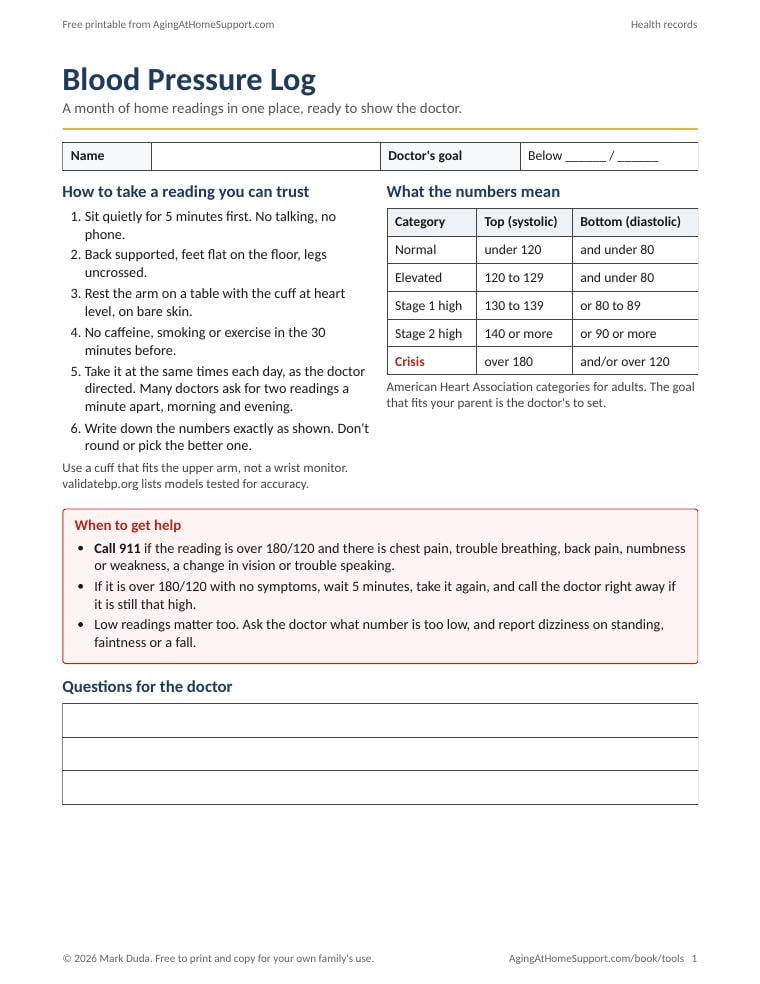
- Page 1: six steps for a reliable reading, the American Heart Association categories, a “when to get help” box, a line for the doctor’s goal, and space for questions
- Pages 2 and 3: days 1 to 31, with time, top number, bottom number and pulse for the morning and the evening, plus a notes column
- A “month at a glance” box for the highest, lowest and average readings, to hand to the doctor
How to take a reading you can trust
Home readings are only as good as the way they are taken. The American Heart Association’s advice, in its news report on monitoring at home, is consistent:
- Choose a cuff that fits and goes on the upper arm. A wrist monitor is less reliable, and validatebp.org lists models tested for accuracy.
- Skip caffeine and smoking, and don’t exercise, for 30 minutes beforehand.
- Sit quietly for five minutes, with no phone or television, in a chair with the back supported, feet flat and legs uncrossed.
- Rest the bare upper arm on a table at heart level, and don’t talk.
- Take two readings at least a minute apart. For a diagnostic week, doctors often ask for two in the morning and two in the evening for seven days. Otherwise follow the doctor’s instructions on how often.
The log has one line per reading. If the doctor wants two, write both in the notes column or on two lines.
What the numbers mean
These are the American Heart Association’s categories for adults. A reading falls in the higher category if either number is in it.
| Category | Top number (systolic) | Bottom number (diastolic) |
|---|---|---|
| Normal | Less than 120 | and less than 80 |
| Elevated | 120 to 129 | and less than 80 |
| Stage 1 high blood pressure | 130 to 139 | or 80 to 89 |
| Stage 2 high blood pressure | 140 or higher | or 90 or higher |
| Hypertensive crisis | Higher than 180 | and/or higher than 120 |
Source: American Heart Association, “Understanding Blood Pressure Readings.” These are general categories, not your parent’s target. The doctor sets that.
When to get help
The American Heart Association says that a reading above 180/120 is a hypertensive crisis. With no symptoms, wait five minutes and take it again, and if it is still unusually high, contact the doctor immediately. With symptoms of chest pain, shortness of breath, back pain, numbness, weakness, a change in vision or difficulty speaking, call 911.
Low blood pressure, dizziness and falls
Most of the attention goes to high readings. In an older adult who is dizzy when standing, a low reading can matter just as much, because a drop in pressure can lead to a fall. The log has a notes column so you can write “dizzy getting up” beside the number. Ask the doctor what reading is too low for your parent, and write it in the questions box. Medicines for blood pressure are among those that can raise fall risk, which is one reason a fall prevention plan starts with a medicine review.
Questions families ask
How often should an older adult check their blood pressure at home?
Follow the doctor’s advice, because the right schedule depends on the person’s condition and medicines. For a diagnostic week, doctors often ask for two readings in the morning and two in the evening for seven days, with each pair at least a minute apart. Write the schedule you are given at the top of the log.
What is a normal blood pressure reading for seniors?
The American Heart Association classes normal blood pressure as less than 120 over 80 for adults. The target for a particular older adult is set by the doctor, and may differ with age, health conditions and the risk of falls, so write the doctor’s goal at the top of the log.
What blood pressure reading is too high?
A reading higher than 180 over 120 is a hypertensive crisis. If there are no symptoms, wait five minutes, take it again, and call the doctor right away if it is still high. If there is chest pain, shortness of breath, back pain, numbness, weakness, a vision change or trouble speaking, call 911.
Should I use an arm or a wrist blood pressure monitor?
Use an upper arm monitor with a cuff that fits. The American Heart Association’s advice favors upper arm cuffs over wrist devices, and suggests choosing a model that has been independently validated, which you can check at validatebp.org.
Should I record both readings or only the better one?
Record both, exactly as shown. Doctors want the real pattern, and picking the lower number defeats the purpose of the log. If the doctor asks for an average, they can work it out from what you have written.
How do I use the log at the doctor’s office?
Bring the pages and the cuff if you can, and hand over the “month at a glance” box with the highest, lowest and average readings. Note any dizziness, falls or symptoms in the notes column, since they help the doctor read the numbers.
Pair it with
- Medication Schedule — record when blood pressure medicines are taken
- Emergency Information Sheet — conditions, allergies and contacts on one page
- Blood Sugar Log — the companion log for glucose readings
- Letter to the Doctor and Appointment Prep Sheet — for the visit
- All the printable tools from the book
Changelog
- 6 November 2026 — Published. Added the free Blood Pressure Log printable.
This page is reviewed every six months, or when the guidance it draws on changes. When it changes, this list will say so.
Sources
- American Heart Association, “Understanding Blood Pressure Readings” — the five categories and the guidance for a reading above 180/120
- American Heart Association News, “Monitoring blood pressure at home can be tricky. Here’s how to do it right” — the measurement steps, upper-arm cuffs and validated devices
Last verified: 6 November 2026 against American Heart Association blood pressure categories and home-monitoring guidance · Next review: May 2027, or when the guidance changes
This page is educational and is not medical advice. Mark Duda is not a physician, nurse, pharmacist or attorney. Blood pressure goals are individual, and only a doctor can set one. Do not change a blood pressure medicine because of a reading on this log. If a reading is dangerously high or comes with symptoms, call 911.