A blood sugar log records each glucose reading with the time it was taken and what was happening around it. This free printable blood sugar log is three pages: a one-page guide that includes the steps for low blood sugar, then a month of readings before meals and at bedtime, with a notes column for meals, medicine and how your parent felt. A number alone says little. The number plus the context is what lets a doctor adjust treatment.
The short version
- The doctor sets the targets. Write them at the top of page one, with how often to check.
- Low blood sugar is under 70 mg/dL, according to the CDC. Give 15 grams of fast sugar, wait 15 minutes and check again.
- Call 911 if the person can’t swallow, won’t wake up or has a seizure.
- Use the notes column. A skipped meal, an illness or a new medicine explains a reading better than the number does.
- Bring the log, and the meter, to every diabetes appointment.
Download it free
3 pages, ready to print on standard letter paper. Page one is a guide, and pages two and three are the month’s log.
Download the PDF →Free. No email required.
Know someone who needs this?
Pass it along — it’s free, and it might be exactly what a family you know is searching for right now.
What’s on it
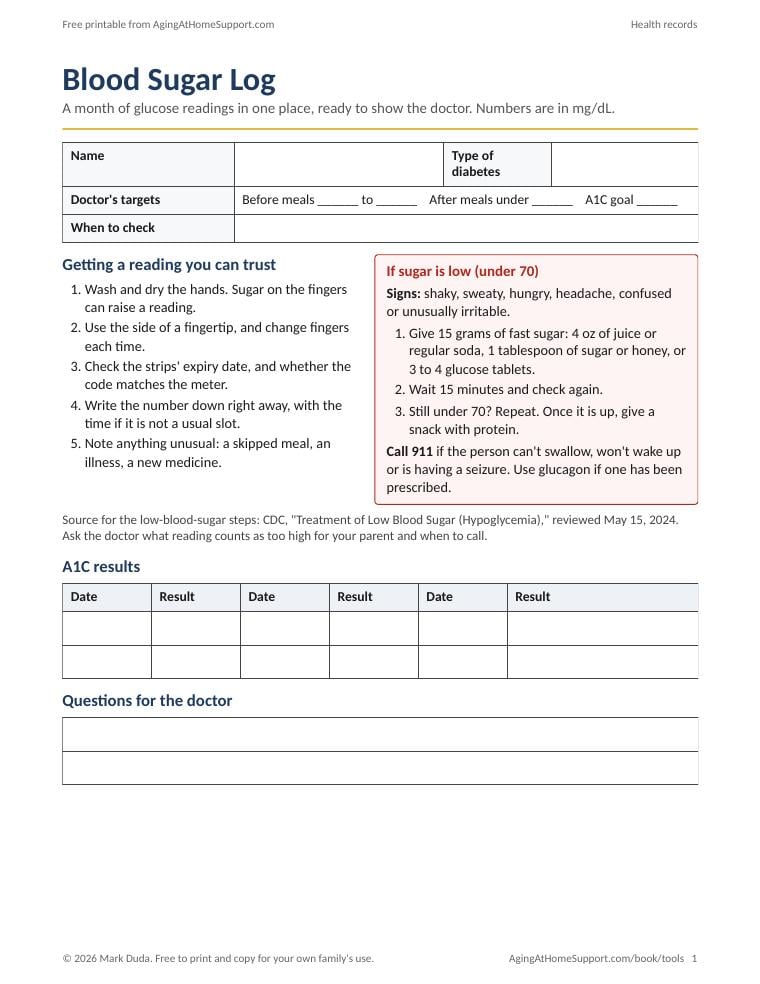
- Page 1: lines for the doctor’s targets and when to check, five tips for a reliable reading, the low blood sugar steps, an A1C results table and a questions box
- Pages 2 and 3: days 1 to 31, with columns for before breakfast, before lunch, before dinner, bedtime and one “other” reading with its time, plus a notes column
- A “month at a glance” box for the highest and lowest readings, the number under 70 and the number over the doctor’s limit
- All values in mg/dL, the unit on U.S. meters
How to use the log
- Ask the doctor for the targets before meals, after meals and for A1C, and the times to check. Write them in the boxes on page one.
- Wash and dry the hands, use the side of a fingertip and change fingers each time. Sugar left on the skin can raise a reading.
- Check the strips’ expiry date, and that the meter and strips match.
- Write the number down right away. If it is not a usual time, write the time in the “other” column.
- Use the notes column for anything unusual: a skipped meal, an illness, a new medicine, a bad night.
- Circle any reading under 70, and count them in the monthly box.
Low blood sugar: the steps
The CDC defines low blood sugar as below 70 mg/dL, and gives this treatment, called the 15-15 rule:
- Eat or drink 15 grams of carbohydrate: 4 ounces (half a cup) of juice or regular soda, 1 tablespoon of sugar or honey, or 3 to 4 glucose tablets.
- Wait 15 minutes, then check again.
- If it is still under 70, repeat. When it is back in the target range, have a snack or meal with protein and carbohydrate.
For a severe low, the CDC says injectable glucagon is the best treatment, and that people should ask their doctor whether they need a prescription and learn how to use it. If the person can’t swallow, won’t wake up or is having a seizure, call 911. Don’t put food or drink in the mouth of someone who isn’t awake.
Why older adults need the notes column
Lows can be easy to miss in an older adult. Shakiness, sweating and hunger can be mistaken for something else, and confusion or unusual irritability can look like a change in memory. A log that records the reading with the meal and the medicine helps the doctor see whether a pattern is a dose that is too high, a skipped meal or something else. It is also why the monthly box counts the readings under 70.
When readings are high
Ask the doctor for the number at which to call, and write it on the questions line on page one. The right limit differs by person, treatment and health, so a figure printed here would be a guess. Very high readings with vomiting, extreme thirst or confusion are a reason to call the doctor or go to the emergency department.
Questions families ask
What should I write in a blood sugar log?
Write the date, the reading, and the time of day it was taken, such as before breakfast or at bedtime. Add notes on meals, medicines, illness and how the person felt. The notes help the doctor understand a high or low reading that the number alone cannot explain.
How often should an older adult check blood sugar?
The doctor sets this, and it depends on the type of diabetes and the medicines used, so write the schedule in the “when to check” box on page one. Some people check only in the morning, and others before every meal and at bedtime. Don’t cut back on checks without asking.
What blood sugar level is too low?
The CDC considers a blood sugar below 70 mg/dL to be low. Treat it at once with 15 grams of fast-acting sugar, wait 15 minutes, and check again. If the person can’t swallow, won’t wake up or has a seizure, call 911.
What do I do for low blood sugar?
Give 15 grams of fast-acting carbohydrate, such as 4 ounces of juice or regular soda, a tablespoon of sugar or honey, or 3 to 4 glucose tablets. Wait 15 minutes and check again, and repeat if the reading is still under 70. Once it recovers, give a snack or meal that includes protein.
Does this log use mg/dL or mmol/L?
It uses mg/dL, the unit on meters sold in the United States. If your meter shows mmol/L, write the number with the unit in the notes column so the doctor can read it correctly.
Should I record medicines and insulin on the blood sugar log?
Yes, in the notes column, along with meals and anything unusual. Record the full medicine schedule on the Medication Schedule, and use the log notes to show what was taken around a particular reading.
Pair it with
- Medication Schedule — the full list of medicines and times
- Emergency Information Sheet — mark insulin and conditions where a crew will see them
- Blood Pressure Log — the companion log for home readings
- Letter to the Doctor and Appointment Prep Sheet — for the visit
- All the printable tools from the book
Changelog
- 6 November 2026 — Published. Added the free Blood Sugar Log printable.
This page is reviewed every six months, or when the guidance it draws on changes. When it changes, this list will say so.
Sources
- CDC, “Treatment of Low Blood Sugar (Hypoglycemia)” — the 70 mg/dL threshold, the 15-15 rule, examples of 15 grams of carbohydrate, glucagon and when to get emergency help (CDC page last reviewed May 15, 2024)
Last verified: 6 November 2026 against CDC guidance on treating low blood sugar · Next review: May 2027, or when the guidance changes
This page is educational and is not medical advice. Mark Duda is not a physician, nurse, pharmacist or attorney. Blood sugar targets and treatment are individual. Do not change a medicine or insulin dose because of a reading on this log. For a severe low, call 911.