Every family has a story it means to write down someday. Then someday passes, and nobody is left who remembers the name of the street or how your grandparents met. This kit turns “we should really ask her” into a few good evenings at the kitchen table: ten questions to start, follow-ups that draw out the stories, questions by topic for later sessions, a session built around old photographs, and a log so every recording can be found again.
The short version
- Start with ten questions, then go deeper with the follow-ups and topic questions on later evenings.
- Record it if they agree. The voice memo app on any phone is enough.
- Bring old photographs. A picture unlocks memories a question can’t.
- Let them wander. The detours are where the best stories are.
- Don’t wait for the perfect time. A plain Tuesday works fine.
Get it: $3.99
A 10-page interview kit, ready to print on standard letter paper. You can also type into it on a computer or tablet and save it.
Buy the PDF →Instant download. See a sample page. Or get all four printables in the Write Your Legacy Set, $11.99.
Know someone who needs this?
Pass it along. It might be exactly what a family you know would love to have.
What’s in it
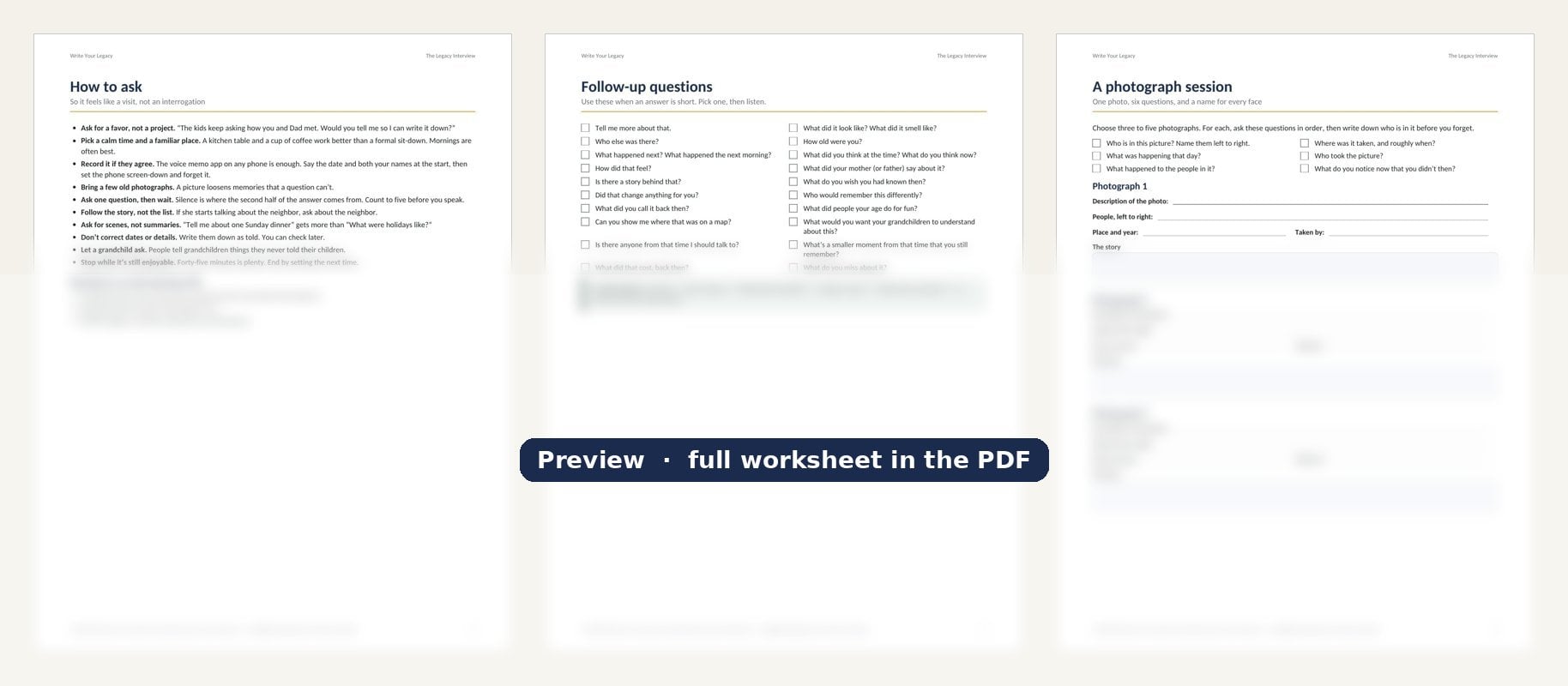
- How to ask so it feels like a visit, not an interrogation, and the questions to avoid opening with
- The ten core questions for the first evening, each with a prompt and room to write
- Twenty follow-up questions that turn short answers into stories
- More questions by topic: childhood, family, love and friendship, work and service, hard times, beliefs and lessons
- A photograph session: six questions for each photo and space for three
- Phone and video calls, and how to adapt when memory is changing
- An after-each-session checklist and “Three things I never knew before tonight”
- A recording log with the people, places and years in each session, so every story can be found later
How to use it
- Ask first. “I’d love to hear some of your stories and write them down. Would you do that with me?”
- Pick a calm time when she is rested, and a familiar place.
- Start the recording by saying the date and both your names.
- Ask the questions in any order. Skip any she doesn’t want to answer.
- Stop while it’s still enjoyable. Finish the rest another day.
- Save a copy somewhere besides your phone, and send it to the family.
How to record it on a phone
On an iPhone, open the Voice Memos app and tap the red button. On most Android phones, open Recorder or Voice Recorder. Set the phone on the table between you, screen down, about an arm’s length away. Turn off the television and close the window. Afterward, rename the recording with her name and the date, then email it to yourself or save it to your cloud storage so it doesn’t live in only one place.
If memory loss is part of the picture, earlier is better, and old memories are often the ones that stay longest. Keep it short, follow her lead, and don’t correct details. Caring for a parent with dementia →
More ways to write your legacy
- Letter to My Grandchildren: one short letter for each stage of their lives.
- The Story Behind What I Leave: a keepsake record of your belongings and the reasons behind your decisions.
- What I Want You to Know: values and guidance, one page at a time.
- What My Family Should Remember: the full guided life story journal.
- Write Your Legacy: all four printables in one place.
Questions families ask
What questions should I ask my parents about their life?
Start with questions that invite a story rather than a fact: where they grew up and what home was like, who raised them, their first job, how they met their spouse, the hardest time they lived through, what they are proudest of, what they believe, the traditions they want kept, and what they want each family member to know. Follow up with “Tell me more about that.”
How do I record a family interview?
Use the voice recorder app that comes on your phone. Sit somewhere quiet, place the phone on the table between you, and say the date and both names at the start. Afterward, rename the file and save a second copy by emailing it to yourself or uploading it to cloud storage.
What if my parent has memory loss?
Do it sooner rather than later, keep sessions short, and choose a time of day when she is at her best. Long-ago memories often last longer than recent ones. Use photographs and music as prompts, follow her lead, and don’t correct details.
Changelog
- 16 November 2026 — Published, with the printable.
This page is educational. It is not legal, financial or medical advice. See our disclaimers.