The hardest calls come at the worst hours, and at 3 a.m. no one should be searching for a phone number. This one-page checklist holds what a family needs near the end of a parent’s life: whom to call, what your parent wants and where the papers are, and the steps after a death, most of which can wait a few days. It comes from Chapter 19 of When Mom or Dad Can No Longer Manage Alone.
The short version
- On hospice, call the hospice, not 911. When death is near or has happened at home, the hospice nurse takes it from there.
- Palliative care and hospice aren’t the same. Palliative care can start at any stage, alongside treatment. Hospice is for the final months.
- Hospice is a choice, not a one-way door. Your parent can stop hospice for any reason and, if eligible, go back to it later.
- Most of the first week can wait. Call the funeral home, then confirm Social Security was told. Ask a lawyer before moving money or the house.
- Grief can start early and include relief. Accept the hospice’s grief support. It’s offered for up to a year.

Get the PDF
1 page, ready to print on standard letter paper.
Get it in All 19 Tools, $6.99 →Secure checkout on Payhip. Instant download.
Know someone who needs this?
Pass it along — it might be exactly what a family you know is searching for right now.
What’s on it
- Who to call: the doctor, the hospice’s 24-hour number, the palliative care team, and the family member who will call everyone else
- What your parent wants: the advance directive and health care proxy, an out-of-hospital do-not-resuscitate form if your state has one, where your parent wants care, and their wishes for a service, with where each paper is kept
- After a death: nine steps to check off as you go, from calling the hospice to ordering death certificates, Social Security, the end of the power of attorney, the estate lawyer, Medicaid estate recovery, grief support and your own doctor
How to use it
- Fill in the first two sections now. Write down the doctor, the hospice’s 24-hour number if there is one, and where the advance directive is kept.
- Put the page where you’ll find it at 3 a.m. Inside a kitchen cabinet door or on the refrigerator works for many families.
- Agree on who calls whom. Decide as a family who calls the hospice and who calls everyone else, so no one is guessing in the moment.
- Ask the hospice early, while things are calm: “What will it look like? Whom do I call, and what will you do when I call?”
- Use the third section after a death. Check off each step as you go, and write down whom you spoke to.
If your parent is on hospice and death is near or has happened, call the hospice’s 24-hour number, not 911. Emergency responders may start resuscitation your parent did not want. If your parent is not on hospice and collapses or stops breathing, call 911. If your parent has died and you’re with them, you don’t have to hurry. You can sit with your parent before anyone arrives.
Palliative care and hospice
Palliative care is specialized medical care for people with a serious illness. It helps relieve pain, discomfort, stress and other symptoms, and it focuses on quality of life for the patient and the family. It’s never too early to start, and your parent can receive it while still getting treatment.
Hospice focuses on the final months of life. Under Medicare, a person with Part A can choose hospice when the hospice doctor and their regular doctor certify a terminal illness with a life expectancy of six months or less. The person accepts comfort care instead of care to cure the terminal illness.
What Medicare’s hospice benefit covers:
- care from the hospice team, including doctor and nursing services, a hospice aide, homemaker services and social work
- short-term inpatient care when pain or symptoms can’t be managed at home
- medical equipment, and medicines for pain and symptoms, with a copayment of up to $5 per prescription
- grief and loss counseling for the family
- short inpatient respite stays, up to five days at a time, so the caregiver can rest; your parent may pay 5% of the Medicare-approved amount
Medicare doesn’t pay for room and board. If your parent lives in a nursing home or assisted living, you’ll still owe the facility for that.
How hospice works day to day
Hospice care is usually given wherever your parent lives, including their home, assisted living or a nursing home. A member of the hospice team is available by phone 24 hours a day, seven days a week. That doesn’t mean a nurse or aide stays in the home around the clock.
Choosing hospice doesn’t mean stopping all medical care. Original Medicare still pays for covered care for health problems that aren’t part of the terminal illness. Your parent can keep seeing their regular doctor if they chose that person as their attending professional. They can stop hospice for any reason and, if eligible, go back to it later.
For a sudden, life-threatening emergency, call 911 if needed, then call the hospice as soon as possible. For worsening symptoms or a non-emergency concern, call the hospice first.
When to ask
Think about raising palliative care when a serious illness is causing pain, distress or repeated hospital stays. Think about raising hospice when treatment is no longer helping, or when your parent says they’d rather focus on comfort. Asking doesn’t commit anyone. Start with your parent’s wishes, and with the advance directive and health care proxy if they have them.
If your parent isn’t on hospice, ask the doctor whether your state has an out-of-hospital order, such as a do-not-resuscitate form, that emergency responders at home will follow. If one exists, keep it where you can find it quickly.
The first week after
- The death certificate. The state issues it after the paperwork is filed, which can take several days. Ask the funeral home how many certified copies you’re likely to need.
- The funeral home. If your parent didn’t choose one, you can call more than one and compare. Funeral providers must give you accurate information when you ask by phone.
- Social Security. Funeral homes generally tell Social Security. If you aren’t sure it was done, call yourself, with your parent’s name, Social Security number, date of birth and date of death. A surviving spouse may be eligible for a one-time $255 death payment.
- Your role as agent ends. Authority under a power of attorney ends at death. The executor named in the will, or a person a court appoints, generally takes over the estate.
- Medicaid and the house. If Medicaid paid for long-term care, the state must try to recover those costs from the estate, with exceptions. Ask a lawyer before anyone sells or transfers the house.
- Hospice support. The hospice must offer grief support to the family for up to a year. Say yes when they call.
What you may feel
You may have started grieving long before your parent died, with each loss along the way. You may have wished it were over, for their sake and yours, and felt ashamed of the wish. Relief and grief fit in the same week, sometimes in the same hour. After a long stretch of caregiving, the quiet can be the hardest part. Go slowly, put off large decisions for a while if you can, and keep your own doctor’s appointments.
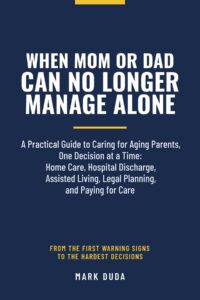
Write down whom to call before you need to. This tool comes from Chapter 19 of When Mom or Dad Can No Longer Manage Alone, which covers palliative care, hospice, the first week after a death, and what you may feel. Out now on Amazon in paperback and Kindle.
Questions families ask
Who do you call when someone dies at home on hospice?
Call the hospice’s 24-hour number, not 911. The hospice nurse confirms the death, completes the required paperwork, and can call the funeral home for you. You don’t have to hurry; you can sit with your parent first.
What is the difference between palliative care and hospice?
Palliative care relieves pain, symptoms and stress for anyone with a serious illness, at any stage, and can be given alongside treatment. Hospice is for the final months of life, when a person chooses comfort care instead of treatment meant to cure the terminal illness.
What does Medicare cover for hospice?
Care from the hospice team, short-term inpatient care for symptoms, medical equipment, medicines for pain and symptoms with a copayment of up to $5, grief counseling, and short respite stays. Medicare doesn’t pay room and board in a nursing home or assisted living.
Can my parent stop hospice care?
Yes. Your parent can stop hospice for any reason and, if they’re eligible, go back to it later. Choosing hospice also doesn’t stop Medicare coverage for health problems unrelated to the terminal illness.
What needs to be done in the first week after a parent dies?
Less than most people fear. Call the funeral home, ask how many death certificates you’ll need, and confirm Social Security was told. If you were the agent under a power of attorney, that authority has ended. Call an estate lawyer before moving money or the house.
Does hospice mean someone stays with my parent around the clock?
No. A hospice team member is available by phone 24 hours a day, and visits follow the care plan. Hospice may provide continuous care at home for short periods during a crisis, but day-to-day care between visits usually comes from family or paid help.
Where it comes from
This tool comes from Chapter 19, “Palliative Care, Hospice and What Comes After,” of When Mom or Dad Can No Longer Manage Alone by Mark Duda. The chapter covers palliative care and hospice, what to expect when death is near, the first week after a death, and what you may feel.
Related reading on this site
- Hospice care
- Palliative care vs. hospice
- How to choose a hospice
- POLST vs. advance directive
- Important Documents Checklist: a printable
- My Limits Plan: a printable
All 19 tools from the book are on the printable tools page.
Changelog
- 9 November 2026 — Expanded with how-to steps, palliative care and hospice, what Medicare covers, how hospice works day to day, when to ask, the first week after a death, sources and common questions.
- 5 November 2026 — Published with the printable from Chapter 19.
Sources
- Hospice Foundation of America, “When death happens at home” (2026). — when death happens at home
- NIH News in Health, “What Is Palliative Care?” (2024). — what palliative care is
- NIA, “What Are Palliative Care and Hospice Care?” (2021). — palliative care and hospice
- Medicare.gov, “Hospice care” coverage page. — Medicare hospice coverage and costs
- CMS, Medicare Hospice: Getting Started, No. 11361 (2025). — getting started with hospice
- CMS, Medicare Hospice Benefits, No. 02154 (2026). — Medicare hospice benefits
- 42 CFR 418.302(e)(5), inpatient respite care. — inpatient respite care
- Medicare.gov, “How hospice works.” — how hospice works
- 42 CFR 418.204(a), continuous home care during periods of crisis. — continuous home care during crises
- FTC, “Funeral providers must give accurate information” (2022). — funeral provider information
- SSA, “When someone dies.” — when someone dies: Social Security
- CFPB, Managing Someone Else’s Money: Help for Agents Under a Power of Attorney (2022). — when an agent’s authority ends
- ABA Section of Real Property, Trust and Estate Law, “Introduction to Wills.” — wills and executors
- ACL, “Medicaid Estate Recovery” (2020). — Medicaid estate recovery
- 42 CFR 418.64(d)(1), bereavement counseling. — bereavement counseling
Last verified: 9 November 2026 against Medicare.gov, CMS, NIA, SSA, FTC and federal regulations · Next review: May 2027
This page is educational and is not medical or legal advice. It doesn’t recommend any hospice or funeral provider. Hospice decisions belong to your parent and their doctors.
The tools may be printed and copied for personal use within your own family. They are not medical, legal or financial advice.
Want every form fillable, in one place?
This tool is also in The Family Care Binder: the fillable caregiver forms in eight tabbed sections, with a clickable contents page. Type into it on screen or print it, and share one file with everyone who helps.
See the Family Care Binder →$19.99 · Instant download · PDF, Excel and Google Sheets