It rarely starts with a diagnosis. It starts with the same story told twice at dinner, a stack of unopened mail, a pot left on the stove, a phone call where something was just slightly off. You notice. The doctor, after fifteen minutes with a charming, well-rested version of your mother, does not. And by the time anyone says the word “dementia” out loud, you’ve usually been carrying it alone for months. This page is the map for everything after that.
Caring for a parent with dementia is different from caring for any other illness, because the disease changes the person who would normally help you make the decisions. With heart failure or a stroke, your parent is still the one steering, and you help. With dementia, the steering slowly passes to you, usually before either of you is ready, and the timing of each handoff (the car keys, the checkbook, the medications, the front door) matters as much as the handoff itself. The good news is that this road is well traveled. The stages are predictable enough to plan for, there is real help available that most families never hear about, and the families who do best are simply the ones who saw the next turn coming. Every guide on this site that touches dementia is collected here, in the order families usually need them.
The short version
- Dementia is an umbrella, not a single disease. Alzheimer’s is the most common cause, but which type she has changes what to expect, so ask the doctor directly.
- The doctor often sees a different person than you do. People with early dementia can hold it together for a short appointment. Bring a written record of what you see at home.
- The legal paperwork has a deadline you can’t see. A power of attorney and an advance directive must be signed while she can still understand them. Do it early.
- Safety risks arrive before families expect them: wandering, driving, the stove, medications, and money. Plan for each before it becomes the emergency.
- Medicare pays for more dementia help than most families know, including a dedicated care-planning visit and, through the GUIDE program (Original Medicare only), a care navigator and up to $2,625 a year toward respite. It does not pay for day-to-day personal care.
- You are the most important part of her care, and the most likely part to break. Planning for your own limits isn’t selfish. It’s how she stays home longer.
New book
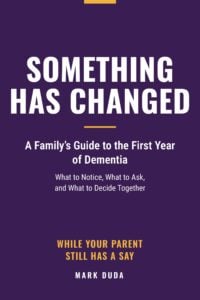
If the diagnosis is new, or not even official yet, start here. Something Has Changed is a new book: a family’s guide to the first year of dementia — what to notice, what to ask, and what to decide together, while your parent can still be part of the deciding.
Buy the paperback on Amazon — $16.99 → · More about the book
What is dementia? (And what it isn’t)
Dementia is not a disease. It’s the name for a group of symptoms (loss of memory, judgment, language, and the ability to handle everyday tasks) severe enough to interfere with daily life. Many different diseases cause it. Alzheimer’s disease is the most common, behind roughly 60 to 80 percent of cases. The others families most often hear about:
- Vascular dementia follows damage to the brain’s blood supply, often after strokes, large or small. It often shows up first as trouble planning, organizing, and making decisions rather than as memory loss, and it can progress in noticeable steps.
- Lewy body dementia can bring vivid visual hallucinations, big swings between clear and confused days, sleep that acts out dreams, and movement problems similar to Parkinson’s. It’s the type where a doctor’s caution about certain medications matters most, so if this is the diagnosis, make sure every prescriber knows it.
- Frontotemporal dementia often begins younger, most often between ages 45 and 64, and tends to change personality, behavior, or language before memory. Families often spend years thinking it’s a midlife crisis or depression.
- Mixed dementia, more than one cause at once, is common in older adults, especially Alzheimer’s together with vascular changes.
Here’s why this matters to you and not just to the neurologist: the type shapes what the next few years look like, which symptoms to watch for, and which medications to be careful with. If your parent has been told “it’s dementia” and nothing more specific, it’s reasonable to ask, “Do you know what’s causing it? Would a memory specialist help us find out?” Also worth knowing: some things that look like dementia aren’t. Thyroid problems, vitamin B12 deficiency, depression, medication side effects, and urinary tract infections in older adults can all cause confusion that improves with treatment. That’s one reason a proper evaluation matters.
Americans age 65 and older are living with Alzheimer’s dementia in 2026, according to the Alzheimer’s Association. Nearly 13 million family members and friends provide their unpaid care. If you’re one of them, you are in very large company.
Where are you right now?
Dementia unfolds over years, and the questions change as it does. Find the stage that sounds like your week and start there.
“Something seems off, but nobody has said the word yet”
- Signs a parent needs help at home: the changes in the house, the car, the fridge, and the mail that tell you more than any conversation will.
- She’s fine for everyone but you: what “showtiming” is, why she can seem completely normal to the doctor and to your siblings, and why it doesn’t mean you’re imagining things.
- Why your parent seems fine at the doctor but not at home: the 15-minute appointment problem, and how to close the gap.
- When your brother thinks she’s fine: what to do when the family doesn’t see what you see.
- What I’m Noticing: a printable log for writing down changes as they happen, so you have dates and details instead of a feeling.
“We’re getting an evaluation, or we just got the diagnosis”
- How to prepare for a memory appointment: what to bring, what to say (and what not to say in front of her), so the doctor sees what you see.
- Letter to the doctor and appointment prep sheet: a printable way to get your observations to the doctor before the visit, without arguing in the exam room.
- How to keep a caregiving log a doctor will act on: the difference between “she’s more confused” and the kind of record that changes a treatment plan.
- The GUIDE Model: Medicare’s dementia care program: a care navigator, a 24/7 line, caregiver training, and respite money. Most families have never heard of it. Check whether a program near you participates.
- What is a power of attorney?: the single most time-sensitive step after a diagnosis, and the one word in it that decides whether it works when you need it.
“She’s living with it, and every day takes work”
- Same question. Same story. Again.: why the repetition happens and the responses that calm it instead of escalating it.
- How to help an elderly parent bathe: why bathing becomes a battle in dementia, and how to make it safe and less frightening for her.
- Managing medications: the point where she can’t be trusted with her own pill box, and the systems that keep her safe.
- Eating and unexplained weight loss: forgetting to eat, forgetting she ate, and when weight loss is a signal.
- Driving and giving up the keys: the hardest conversation in early dementia, and how to have it before an accident has it for you. Pair it with the driving observation checklist.
- Home safety checklist: a room-by-room walk-through, with the dementia-specific risks (stove, doors, water temperature, sharp tools) added in.
- Hiring an in-home caregiver: when it’s time to bring in help, and how to find a private-duty aide.
“It’s getting harder, and home may not work much longer”
- When dementia gets harder: the middle stage, when behavior changes, nights get rough, and the family has to decide what comes next.
- Respite care: what it is, what it costs, and who pays, including the GUIDE program’s respite benefit.
- When a parent can no longer live alone: the options, the costs, and how to tell when you’ve reached this point.
- Moving a parent into your home: what changes for your household, and what to set up before the move.
- Choosing assisted living, memory care, or a nursing home: what each actually provides, what memory care adds, and the questions that separate good ones from good brochures. Bring the tour and contract questions.
- Moving a parent: timeline and first 30 days: how to plan the move, and why the first month is harder on her (and you) than it looks.
“We’re in the late stage”
- What is palliative care?: comfort-focused care that can start long before hospice and doesn’t require giving anything up.
- Hospice care at home: what actually shows up: what the hospice benefit provides for a person with advanced dementia, and what still falls to family.
- How to choose a quality hospice: and the warning signs to watch for. Then compare the hospices that serve your ZIP code.
- When a doctor says “comfort care”: what the words mean, and what to ask next.
- When the Time Comes: a printable for writing down what she would want while you still can.
“I’m the one who’s falling apart”
- When you can’t do it anymore: caregiver burnout, the signs you’ve passed your limit, and what to change first.
- My Limits Plan: a printable to decide, in advance, what you can and can’t do, before exhaustion decides for you.
- When you live four states away: how to help, and how to know what’s really happening, from a distance.
The stages of dementia, the way families live them
Doctors describe dementia in stages, sometimes three, sometimes five or seven. The labels matter less than this: each stage changes what she can do safely, and so it changes your job. Every person moves through them at a different pace. According to the Alzheimer’s Association, a person with Alzheimer’s lives four to eight years after diagnosis on average, and some live as long as 20. The middle stage is usually the longest. Here’s what each stage tends to look like from the family’s side of the table.
Early stage: she’s still herself, with gaps
She may still live alone, drive, and handle much of her day. What changes first is the hard stuff: bills, appointments, new information, complicated recipes, and finding the right word. She may repeat questions and lose things. She may also be frightened, embarrassed, or angry about it, and hide it well. This is the planning window. She can still take part in decisions about her money, her care, and her wishes, and she can still sign legal documents. Families who use these months well have far fewer impossible choices later. Your jobs right now: get a proper diagnosis, get the paperwork done, quietly take over the riskiest tasks (finances and medications are usually first), and start the driving conversation.
Middle stage: she needs someone nearby
This is usually the longest stage and the hardest on caregivers. She’ll need help with more of the day: choosing clothes, bathing, taking medications, remembering to eat. Behavior often changes: restlessness and confusion late in the day (often called sundowning), suspicion, agitation, trouble sleeping, and wandering. She may not recognize that she needs help, which makes accepting help harder. Your jobs shift to safety and structure: a predictable routine, a safer house, a plan for wandering, and, critically, regular breaks for you, through family, adult day programs, an in-home aide, or respite care. This is also when many families face the question of whether home still works.
Late stage: she needs care around the clock
In the late stage, a person with dementia needs help with nearly everything: eating, moving, using the bathroom. Speech may shrink to a few words. Swallowing gets harder, and infections like pneumonia become more common. What still reaches her: your voice, touch, music she loved, a familiar face. Your jobs become comfort and advocacy: making sure the care plan matches what she would have wanted, asking about palliative care and hospice, and deciding where she’ll be most comfortable. Medicare’s hospice benefit covers people with advanced dementia when a doctor certifies that life expectancy is six months or less if the disease follows its usual course, and it can be provided at home or in a nursing facility.
Dementia safety: the risks that arrive before families expect them
Most dementia emergencies aren’t medical. They’re a car, a stove, a door, a pill bottle, or a phone call from a scammer. Each one is easier to prevent than to recover from.
- Wandering. The Alzheimer’s Association estimates that 6 in 10 people living with dementia will wander at least once, and many do it repeatedly, even in the early stage. Warning signs include coming back from a routine walk or drive later than usual, trying to “go home” while already at home, and restlessness at the same time each day. Prepare before it happens: a recent photo, an ID bracelet or a GPS device, door chimes, and neighbors who know. If she goes missing, search the immediate area right away. If you haven’t found her within 15 minutes, call 911 and tell them she has dementia. If the weather is dangerous or something feels wrong, don’t wait: call immediately.
- Driving. A diagnosis doesn’t automatically mean she must stop that day, but dementia always ends driving eventually, and the decision is better made by the family and the doctor than by an accident. How to handle the driving conversation →
- The kitchen and the house. Stoves left on, scalding water, falls, and medications taken twice. Auto shut-off devices, a lower water heater setting, locked medication, and the fall-prevention basics prevent most of it.
- Money and scams. Changes in judgment often show up in the checkbook before anywhere else: unpaid bills, unusual purchases, new “friends” on the phone. People with dementia are prime targets for fraud. How to protect a parent’s money →
- Firearms. If there are guns in the home, talk with her doctor and family about removing or securing them. Confusion and firearms are a dangerous combination.
The paperwork that has a deadline
This is the part families most often get wrong, and the one that’s hardest to fix later. Legal documents only work if she understood them when she signed them. Once dementia has progressed far enough that she can’t, the family’s option is usually guardianship through the courts, which is slower, more expensive, and more public than any of the documents below. In the early stage, most people can still sign. So the time to act is now, even if it feels too soon.
- A durable financial power of attorney, so someone she trusts can pay bills and manage accounts when she can’t. What a power of attorney is, and the word that decides whether it works →
- A health care proxy and advance directive, naming who makes medical decisions and recording what she’d want. Advance directives: start here → and how to fill one out →
- A POLST, when the time is right. Later in the illness, a doctor-signed POLST turns her wishes into medical orders that paramedics can follow. POLST vs. advance directive →
- Everything else in one place: bank accounts, insurance, passwords, and the location of the will. Getting your affairs in order checklist →
Just as important as the documents is the conversation behind them. Ask her, while she can still tell you, what matters most to her: where she wants to live, what kind of care she would and wouldn’t want, what a good day looks like. The Parent Preferences and Wishes printable gives you a gentle way in.
Who’s on the care team, and who does what
- Her primary care doctor often starts the evaluation and coordinates everything else. Medicare covers a dedicated visit for cognitive assessment and care planning (more below).
- A memory specialist, usually a neurologist, geriatrician, or geriatric psychiatrist, sometimes at a memory clinic, can pin down the type of dementia and guide treatment.
- A GUIDE care navigator, if she has Original Medicare and a GUIDE program serves your area, coordinates care, trains you, and connects you to services, with a support line that answers around the clock.
- Home health (nursing and therapy at home, paid by Medicare) only when she has a skilled need, such as after a hospital stay or a fall. It’s short-term and doesn’t provide daily supervision. Home health vs. home care →
- In-home aides help with bathing, dressing, meals, and companionship, usually paid privately. Find home care agencies near you → or find a private-duty aide →
- Adult day programs give her structure and company during the day and give you hours to work or rest.
- Hospice, in the late stage, adds a nurse, an aide, a social worker, chaplain support, medications, and equipment related to the illness, at home or in a facility.
- You, the constant across all of it. Medicare built its GUIDE program around a simple idea: when family caregivers get training, backup, and real breaks, people with dementia can stay at home longer.
Two calls worth making early: the Alzheimer’s Association 24/7 Helpline at 800-272-3900 (for any type of dementia, not just Alzheimer’s), and your local Area Agency on Aging, which you can find through the Eldercare Locator at 1-800-677-1116.
What Medicare covers for dementia, and the gap
Medicare covers the medical side of dementia care, and more of it than most families realize:
- The diagnosis and medical care: doctor visits, specialist visits, testing, and covered medications.
- A cognitive assessment and care plan visit. When a doctor sees signs of cognitive impairment, Medicare covers a separate, longer visit to assess thinking and memory, review medications and safety, check on caregiver support, and write a care plan. A family member or other caregiver is expected to be there to describe what’s happening at home. It can be done in person or by telehealth. Usual Part B cost-sharing applies. Ask for it by name: “a cognitive assessment and care plan visit.”
- The GUIDE Model, a Medicare program for people with dementia and their caregivers, delivered through participating dementia care programs. It is only for people with Original Medicare who live at home or in the community: Medicare Advantage members, people on hospice, and nursing home residents are not eligible. It includes care navigation, caregiver education and support, a 24/7 support line, and, for eligible people with moderate to severe dementia who have a caregiver, up to $2,625 a year toward respite: in-home care, adult day programs, or a short facility stay. The respite money goes to the program arranging the care, not to the family as cash. How GUIDE works and who qualifies →
- Home health, when there’s a skilled need and she’s considered homebound.
- Hospice, in the late stage, when eligibility rules are met.
And the gap, which is large with dementia because the need is so long: Medicare does not pay for ongoing personal care or supervision, the hands-on help with bathing, dressing, and meals, or someone to make sure she doesn’t leave the house at 2 a.m. It also doesn’t pay for room and board in assisted living or memory care. Families cover that with savings, long-term care insurance, Medicaid home care waivers, and, for veterans and surviving spouses, VA Aid and Attendance. What in-home care actually costs →
Get specific about how much help she needs
With dementia, the amount of help needed creeps up so gradually that families often underestimate it until something goes wrong. A clear picture of what she can and can’t do safely today is what every good decision, and every conversation with a doctor or an agency, is built on.
The care needs checklist walks the same fourteen questions a visiting nurse walks and ends with something concrete: which daily tasks need hands-on help, roughly how many hours a week, and which gaps are genuine safety issues.
Take the care needs checklist →
No email needed. Your answers stay in your browser.
Put her care on paper
So much of dementia care lives in one person’s head: what calms her, what sets her off, which pills, what to do if she walks out the door. The Dementia Home Support Plan is a 17-page fill-in workbook that gets it written down, with a wandering plan, a hospital page that speaks for her, and an abilities check you repeat every three months so you can see the change. It is $19.99 and one purchase covers the whole family. For the first year after the diagnosis, Something Has Changed is a family’s guide to what to notice, what to ask and what to decide together. It sits with the rest of the books for families caring for an aging parent.
This is one of several conditions we map this way
Dementia is part of By Diagnosis, our guides for families caring for a parent through a specific illness, each organized the same way: what daily life takes, when to escalate, and what the road ahead looks like. Dementia often travels with other conditions. If your parent also has Parkinson’s or has had a stroke, those guides are worth reading alongside this one.
Know someone who needs this?
Pass it along. It might be exactly what a family you know is trying to sort out right now.
Questions families ask
What are the first steps after a parent is diagnosed with dementia?
Start with three things. First, ask the doctor what type of dementia it is and what to expect, and ask about a Medicare cognitive assessment and care plan visit if one hasn’t been done. Second, while your parent can still understand and sign them, put a durable financial power of attorney, a health care proxy, and an advance directive in place. Third, look at the biggest safety risks, usually driving, medications, money, and the stove, and decide who will watch each one. It also helps to call the Alzheimer’s Association 24/7 Helpline at 800-272-3900 and, if your parent has Original Medicare, to check whether a Medicare GUIDE dementia care program serves your area.
What is the difference between dementia and Alzheimer’s?
Dementia is the general term for a decline in memory, thinking, and daily functioning that is severe enough to interfere with everyday life. Alzheimer’s disease is one specific cause of dementia, and the most common one, accounting for roughly 60 to 80 percent of cases. Other causes include vascular dementia, Lewy body dementia, frontotemporal dementia, and mixed dementia. The type matters because it affects which symptoms appear first, how the illness tends to progress, and which medications need extra caution.
Does Medicare pay for dementia care?
Medicare pays for the medical side of dementia care: doctor and specialist visits, testing, covered medications, a dedicated cognitive assessment and care plan visit, home health when there is a skilled need, and hospice in the late stage. For people with Original Medicare, the GUIDE Model adds care navigation, caregiver support, and up to $2,625 a year toward respite for those with moderate to severe dementia who have a caregiver. Medicare Advantage members are not eligible for GUIDE. Medicare does not pay for ongoing personal care or supervision at home, or for room and board in assisted living or memory care. Families usually cover those costs with savings, long-term care insurance, Medicaid, or VA benefits.
When should a person with dementia stop living alone?
There is no single moment, but common signs include getting lost or wandering, leaving the stove on, missing or doubling medications, not eating, unpaid bills or scams, falls, and confusion about the time of day. Many people with early dementia live alone safely with support, but as the illness reaches the middle stage, most need someone nearby for at least part of the day. A care needs checklist and an honest look at nights, when confusion and wandering are often worse, help families decide.
How long does each stage of dementia last?
It varies widely from person to person and by type of dementia. According to the Alzheimer’s Association, a person with Alzheimer’s lives four to eight years after diagnosis on average, and some live as long as 20 years. The middle stage is usually the longest. Rather than planning around a timeline, families do better planning around abilities: handle legal and financial decisions in the early stage, build safety and support in the middle stage, and focus on comfort, including palliative care and hospice, in the late stage.
Can someone with dementia still sign a power of attorney?
Often yes, especially in the early stage. What matters is whether the person understands what the document does at the time they sign it, not whether they have a diagnosis. Capacity can fluctuate, so it is best to act as early as possible and to involve an attorney, who can document that the person understood. If dementia has progressed too far, the family may need to seek guardianship through the courts, which is slower and more costly.
Changelog
- 16 November 2026 — Published as the hub of the dementia cluster, gathering every dementia guide and printable on the site by stage. Prevalence (7.4 million Americans 65+ with Alzheimer’s dementia in 2026; nearly 13 million unpaid caregivers) verified against the Alzheimer’s Association 2026 Facts and Figures report; Alzheimer’s share of dementia cases, wandering frequency, and the 15-minute search guidance verified against Alzheimer’s Association materials; Medicare cognitive assessment and care plan coverage verified against CMS; GUIDE Model services, the Original Medicare requirement, and the respite cap ($2,625 for the year that began July 2026) verified against CMS model materials; stage descriptions and survival range verified against the Alzheimer’s Association.
This page is reviewed every six months, and immediately on a relevant change. When it changes, this list will say so.
Sources
- Alzheimer’s Association — 2026 Alzheimer’s Disease Facts and Figures (7.4 million Americans age 65 and older living with Alzheimer’s dementia; nearly 13 million unpaid caregivers providing more than 19 billion hours of care)
- Alzheimer’s Association — types of dementia (Alzheimer’s as the cause of roughly 60 to 80 percent of cases), wandering (6 in 10 people with dementia wander at least once), and the 24/7 Helpline, 800-272-3900
- National Council on Aging, citing the Alzheimer’s Association — calling 911 if a person with dementia isn’t found within 15 minutes of searching
- Centers for Medicare & Medicaid Services — Cognitive Assessment & Care Plan Services (CPT 99483): what the visit includes, the independent-historian requirement, telehealth coverage, and Part B cost-sharing
- Centers for Medicare & Medicaid Services — GUIDE (Guiding an Improved Dementia Experience) Model: the July 2024 to 2032 model period, care navigation, caregiver support, 24/7 access, and respite payments of up to $2,625 per eligible person per year (2026), paid to participating programs
- Alzheimer’s Association, Stages of Alzheimer’s — early, middle, and late stages; average survival of four to eight years after diagnosis, up to 20; the middle stage as typically the longest
- National Institutes of Health (National Institute on Aging; National Institute of Neurological Disorders and Stroke) — types of dementia, including vascular, Lewy body, frontotemporal, and mixed dementia
- Medicare — hospice eligibility (terminal illness with a life expectancy of six months or less if the illness runs its normal course) and what home health and hospice cover
- Eldercare Locator (U.S. Administration for Community Living) — 1-800-677-1116, for finding the local Area Agency on Aging
Last verified: 16 November 2026 against the Alzheimer’s Association 2026 Facts and Figures report, CMS cognitive-assessment and GUIDE Model materials, and Alzheimer’s Association safety guidance · Next review: May 2027, or immediately on a relevant change
This page is educational and is not medical or legal advice. Mark Duda is not a physician, a nurse, or an attorney. Dementia affects every person differently, and decisions about diagnosis, treatment, and medications should be made with her own care team, whose guidance takes precedence over the general information here. For legal documents, talk with an attorney in her state. If a person with dementia is missing or in danger, call 911. See our disclaimers.