When something happens, families lose hours looking for a card, a policy or the name of a lawyer. This checklist is an afternoon plan for gathering a parent’s key information with them, and a one-page index of where everything is and who can act, so the family can find it in an emergency.
The short version
- Record where things are, not every account number.
- Start with the emergency basics: conditions, allergies, medicines, doctors and contacts.
- Find the legal papers and note who is named in each.
- Keep it in one place, and tell two people where.
Download the checklist
3 pages, ready to print on standard letter paper. Print it and write by hand, or type into it on a computer and save it.
Download the PDF →No cost. No email required.
Know someone who needs this?
Pass it along. It might be exactly what a family you know needs this week.
The checklist
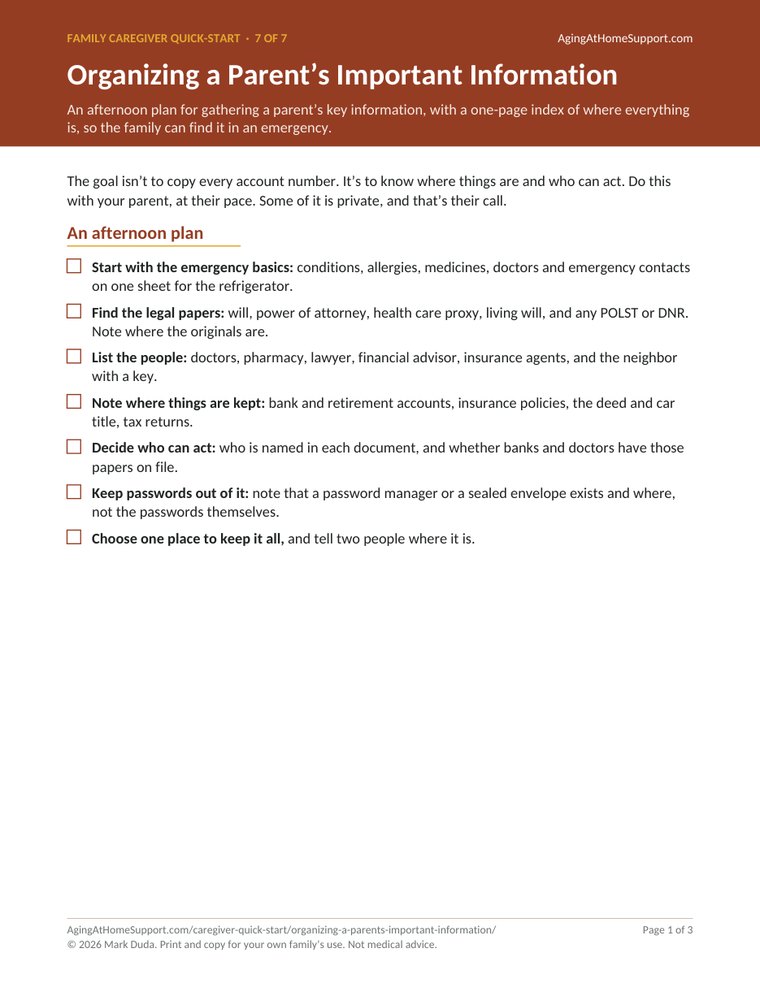
An afternoon plan
- The emergency basics on one sheet for the refrigerator.
- The legal papers: will, power of attorney, health care proxy, living will, and any POLST or DNR. Note where the originals are.
- The people: doctors, pharmacy, lawyer, financial advisor, insurance agents, the neighbor with a key.
- Where things are kept: bank and retirement accounts, insurance policies, the deed and car title, tax returns.
- Who can act: who is named in each document, and whether banks and doctors have those papers on file.
- Passwords: note that a password manager or sealed envelope exists and where, not the passwords.
- One place for all of it, and tell two people where.
The one-page index
Will · financial power of attorney · health care proxy and living will · POLST or DNR · Medicare and insurance cards · medicine list · bank accounts · retirement and pensions · life insurance · long-term care insurance · house deed or lease · car title and insurance · tax returns · safe deposit box and key · spare house key · password manager or envelope. For each: where it’s kept, and who to call.
Do it with your parent, at their pace
This is your parent’s information, and some of it is private. Go at their pace, start with what they’re comfortable sharing, and remember that the goal is to know where things are and who can act, not to take anything over. Never write full Social Security numbers, account numbers or passwords on a sheet that stays in the house.
If your parent is ready to put everything down in their own words, including their wishes, What My Family Needs to Know is a complete planner for that. The Important Documents Checklist goes deeper on the legal papers.
Keeping track for the whole family?
The Family Care Binder brings the caregiving forms together in one fillable file you can share: contacts, medicines, appointments, visit notes and more. $19.99.
Questions families ask
What important information should I have for an aging parent?
The emergency basics (conditions, allergies, medicines, doctors and contacts); where the will, power of attorney, health care proxy, living will and any POLST or DNR are kept; their insurance; where bank, retirement and insurance accounts are; and who is authorized to act on their behalf.
Should I keep my parent’s passwords and account numbers?
It’s safer to record where they are kept, such as a password manager or a sealed envelope, than to write them on a sheet in the house. Keep full Social Security numbers and account numbers off any list that others could see.
Who can act for my parent with banks and doctors?
Usually the person named in a financial power of attorney for money matters, and the person named as health care agent or proxy for medical decisions when your parent can’t decide. Banks and doctors often need a copy of the document on file before they’ll work with you.
Your next step
Keep it going: the Emergency Information Sheet and Medication Schedule are the two pages families use most.
Go deeper
- Important Documents Checklist
- Emergency Information Sheet
- Getting your affairs in order
- Protecting a parent’s money
- POLST vs. advance directive
The Family Caregiver Quick-Start
- Mom or Dad Can No Longer Live Alone: What to Do First
- Signs a Parent Needs More Help
- Preparing for a Family Care Meeting
- Choosing a Home Care Agency
- Preparing for a Home Care Assessment
- What to Bring to a Medical Appointment
- Organizing a Parent’s Important Information (this page)
See all seven, organized by where your family is, on the Family Caregiver Quick-Start page.
Changelog
- 24 November 2026 — Published with the printable checklist.
Sources
- Consumer Financial Protection Bureau, “Managing someone else’s money” — guides for agents under a power of attorney and other fiduciaries
Last verified: 24 November 2026 · Next review: May 2027
This page and checklist are educational and are not medical, legal or financial advice. Health questions belong with your parent’s doctor. Mark Duda is not a physician, nurse or attorney.
The checklists may be printed and copied for personal use within your own family.