The hospital has started saying “discharge,” and the date keeps moving. This checklist covers the days before your parent comes home: who in the family does what, what has to be delivered or picked up, what to bring, and the papers to have in your hand before anyone leaves the room.
The short version
- Start in the first day or two of the stay. Find the discharge planner and say what the family can and can’t do.
- Put one name next to each job: the ride, the first nights, prescriptions, the first home health visit.
- Ask for equipment to arrive before your parent does, and practice any care you’ll be expected to do while a nurse watches.
- Don’t leave without the medicine list, follow-up plan, warning signs and an after-hours number.
Download the checklist
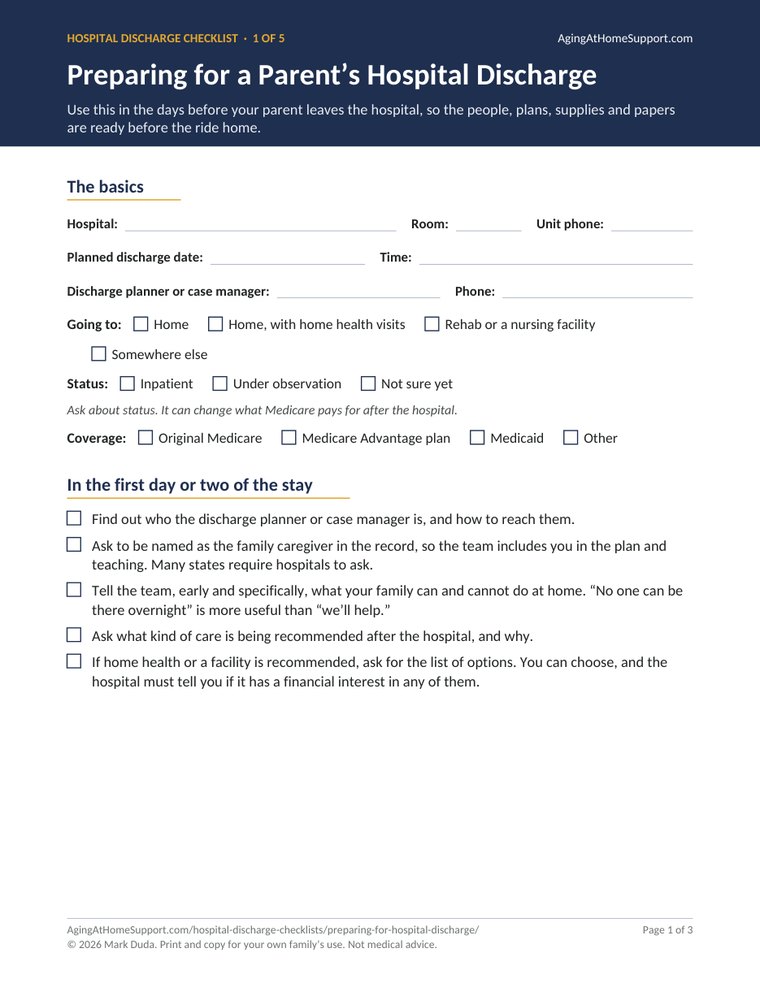
3 pages, ready to print on standard letter paper. Print it and write by hand, or type into it on a computer and save it.
Download the PDF →No cost. No email required.
Know someone who needs this?
Pass it along. It might be exactly what a family you know needs this week.
What’s on it
- The basics: hospital, discharge date, the planner’s name, where your parent is going, inpatient or observation, and coverage
- The first day or two: five things to settle early, including being named as the family caregiver
- Who does what: a table for the ride home, the first nights, prescriptions, appointments, meals and updates
- Before discharge day: teaching, equipment, the pharmacy, home health and getting the house ready
- Have these in hand: ten things to collect before you leave
- If you don’t think your parent is ready: the Medicare notice that explains how to ask for a fast review
How to use it
- Print it as soon as discharge comes up, not on the day itself. Most of it takes a day or two to arrange.
- Fill in “who does what” together, on a call or in the hallway. One name per job, even if others help.
- Bring it to every conversation with the team. Write the planner’s name and number at the top.
- Tick the “have these in hand” list in the room, before your parent is wheeled to the door.
Why the first day or two matters
Federal rules require hospitals to identify patients who need discharge planning early in the stay, and to involve the patient and the family caregiver in the plan. In most states, a law known as the CARE Act also requires hospitals to ask who the family caregiver is, record that person in the chart, tell them about the discharge, and offer to teach any care they will be expected to do.
That only helps if the team knows what your family can actually do. “We’ll manage” leads to a plan built on help that doesn’t exist. “Nobody can be there overnight for the first week” leads to a different plan, or to a different place to go.
Want the whole discharge in one place?
These checklists are each one piece. Coming Home from the Hospital is a 21-page fill-in workbook that puts them together: the questions for the discharge planner, every medication change, the warning signs, the equipment and a two-week plan the family can share. $14.99.
If you don’t think your parent is ready
Under Original Medicare, the hospital must give your parent a notice called the Important Message from Medicare, which explains how to ask for a fast review if you believe the discharge is too soon. Follow its directions and contact the organization named on it no later than the day of discharge. With a Medicare Advantage plan, the plan has its own process; ask the plan and the discharge planner. For what to say and how to say it, read They’re sending her home Thursday.
Questions families ask
How do I prepare for a parent’s hospital discharge?
Start early in the stay. Find the discharge planner, tell the team what the family can and cannot do, and ask what care is recommended after the hospital. Then assign each job to one person: the ride home, the first nights, prescriptions and the first home health visit. Arrange equipment before the day, and leave with the medicine list, follow-up plan, warning signs and an after-hours number.
What should I bring to the hospital on discharge day?
Clothes and shoes that fit over any swelling, a coat, glasses, hearing aids, dentures and house keys. Bring the checklist too, so you can confirm the medicine list, appointments, warning signs and equipment before you leave.
Can the hospital discharge my parent if we aren’t ready?
The hospital decides when a patient no longer needs hospital care, but under Medicare your parent can ask for a fast review. The Important Message from Medicare explains how. Contact the organization named on it no later than the day of discharge.
The rest of this set
- Questions to Ask Before Leaving the Hospital: 14 questions for the doctor, nurse and pharmacist on discharge day, with room for the answers
- The First 72 Hours at Home: a plan and three-day log for the first days home, with warning signs and who to call
- Understanding Medication Changes After Hospitalization: a comparison chart for new, changed and stopped medicines, and questions for the pharmacist
- Getting the Home Ready for Home Health Services: what to set up before the first home health visit, what to have ready, and what to ask the agency
All five are on the hospital discharge checklists page.
Related reading on this site
- Questions to Ask the Hospital Discharge Planner (printable)
- They’re sending her home Thursday: what to do when discharge feels too soon
- Inpatient vs observation: the word that decides what Medicare pays
- Why the hospital is discharging your parent faster
- The Discharge Directory: home care, home health and hospice in every state
Changelog
- 24 November 2026 — Published with the printable checklist.
Sources
- 42 CFR 482.43, hospital discharge planning — early planning, the patient’s and caregiver’s role, provider lists and freedom of choice
- AARP Public Policy Institute, the CARE Act — state laws requiring hospitals to record a family caregiver, notify them of discharge and offer training
- Medicare.gov, “Fast appeals” — the Important Message from Medicare and the deadline to ask for a review
- Medicare, “Your Discharge Planning Checklist” (CMS Product 11376) — Medicare’s own checklist for patients and caregivers preparing to leave a hospital
Last verified: 24 November 2026 against 42 CFR 482.43, Medicare.gov and AARP’s CARE Act summary · Next review: May 2027, or when the rules change
This page and checklist are educational and are not medical or legal advice. Follow the instructions of the hospital and your parent’s doctors, and ask them about anything that is unclear. Mark Duda is not a physician, nurse or attorney. Medicare Advantage plans have their own rules; check with the plan.
The checklists may be printed and copied for personal use within your own family.