The first three days at home are when new medicines, new routines and new questions all arrive at once, and the hospital team is no longer down the hall. This checklist gives you a plan for the first few hours and the first day, a place to write down who to call, and a simple three-day log to bring to the first follow-up visit.
En español: Las primeras 72 horas en casa después del hospital (lista para imprimir).
The short version
- Emergencies first: trouble breathing, chest pain, fainting, signs of a stroke or severe bleeding mean call 911.
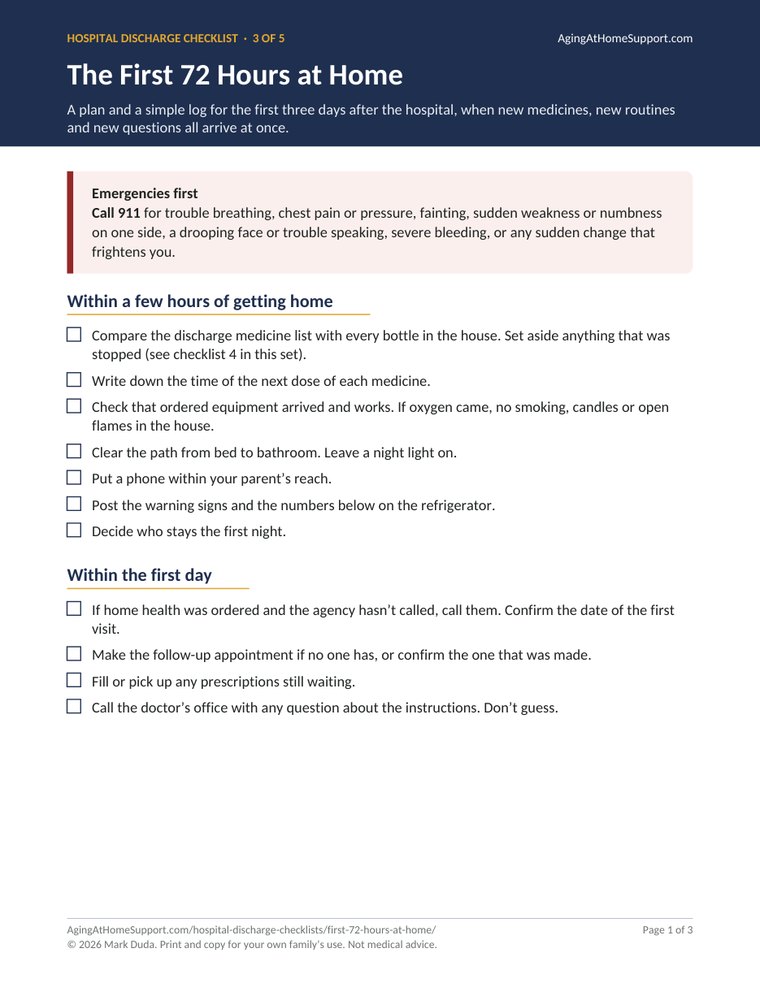
- In the first few hours: match the medicine bottles to the discharge list, check the equipment, clear the path to the bathroom.
- In the first day: confirm the first home health visit and the follow-up appointment.
- Keep the three-day log. A few words a day answers most of the doctor’s questions at the follow-up.
Download the checklist
3 pages, ready to print on standard letter paper. Print it and write by hand, or type into it on a computer and save it.
Download the PDF →No cost. No email required.
Know someone who needs this?
Pass it along. It might be exactly what a family you know needs this week.
What’s on it
- Emergencies first: the signs that mean call 911
- Within a few hours of getting home: medicines, equipment, the path to the bathroom, the phone, the posted numbers
- Within the first day: home health, the follow-up appointment, prescriptions still waiting
- Who to call: doctors, home health, pharmacy, the hospital and the family member on call
- Warning signs the care team told us to watch for: what to do and who to call for each
- Three-day log: medicines, eating, walking, bathroom, pain, wound, sleep, mood and questions
How to use it
- Fill in “who to call” and the warning signs before you leave the hospital, while the team is there to ask.
- Put page 1 on the refrigerator the day your parent comes home.
- Pass the log between whoever is on shift. A few words in each box is enough.
- Bring the log to the first follow-up visit.
Why the first days need a plan
Most of what goes wrong after a hospital stay is ordinary: a medicine that was stopped gets taken from the old bottle, the home health agency never calls, the follow-up appointment isn’t made, a warning sign gets explained away until the weekend. None of it is anyone’s fault, and most of it is preventable with a list and a name next to each job.
Home health agencies are generally required to make the first visit within 48 hours of the referral or of your parent getting home, unless the doctor orders a different start date. If no one has called by the end of the first day, call them.
Want the whole discharge in one place?
These checklists are each one piece. Coming Home from the Hospital is a 21-page fill-in workbook that puts them together: the questions for the discharge planner, every medication change, the warning signs, the equipment and a two-week plan the family can share. $14.99.
Warning signs: ask, don’t guess
The signs that matter depend on why your parent was in the hospital. Someone home after heart failure is usually told to watch weight and swelling; someone home after surgery is told to watch the incision. Ask the hospital team which signs matter for your parent, what to do for each, and who to call, and write them in the table on page 2.
Questions families ask
What should I do in the first 24 hours after a parent comes home from the hospital?
Compare the medicine bottles with the discharge list and set aside anything that was stopped, write down the next dose times, check the equipment, clear the path to the bathroom, post the warning signs and phone numbers, and confirm the first home health visit and the follow-up appointment.
When should I call 911 after a hospital discharge?
Call 911 for trouble breathing, chest pain or pressure, fainting, sudden weakness or numbness on one side, a drooping face or trouble speaking, severe bleeding, or any sudden change that frightens you. For other changes, follow the warning signs the hospital gave you and call the doctor.
When does home health come after a hospital discharge?
Under federal rules, the agency’s first visit is generally made within 48 hours of the referral or of the patient’s return home, unless the doctor orders a different start date. If you haven’t heard from the agency by the end of the first day home, call them.
The rest of this set
- Preparing for a Parent’s Hospital Discharge: the days before discharge: who does what, equipment, prescriptions and the papers to have in hand
- Questions to Ask Before Leaving the Hospital: 14 questions for the doctor, nurse and pharmacist on discharge day, with room for the answers
- Understanding Medication Changes After Hospitalization: a comparison chart for new, changed and stopped medicines, and questions for the pharmacist
- Getting the Home Ready for Home Health Services: what to set up before the first home health visit, what to have ready, and what to ask the agency
All five are on the hospital discharge checklists page.
Related reading on this site
- Emergency Information Sheet: a printable for the refrigerator door
- Medication Schedule: a printable daily and weekly chart
- Fall prevention at home
- Recovering from surgery at home
- They’re sending her home Thursday: what to do when discharge feels too soon
Changelog
- 24 November 2026 — Published with the printable checklist.
Sources
- 42 CFR 484.55, home health comprehensive assessment — the initial visit within 48 hours of referral or return home, unless the doctor orders another start date
- Medicare.gov, “Home health services” — who qualifies, part-time or intermittent care, aide services and costs
- Medicare, “Your Discharge Planning Checklist” (CMS Product 11376) — Medicare’s own checklist for patients and caregivers preparing to leave a hospital
Last verified: 24 November 2026 against 42 CFR 484.55 and Medicare.gov · Next review: May 2027, or when the rules change
This page and checklist are educational and are not medical or legal advice. Follow the instructions of the hospital and your parent’s doctors, and ask them about anything that is unclear. Mark Duda is not a physician, nurse or attorney. Medicare Advantage plans have their own rules; check with the plan.
The checklists may be printed and copied for personal use within your own family.