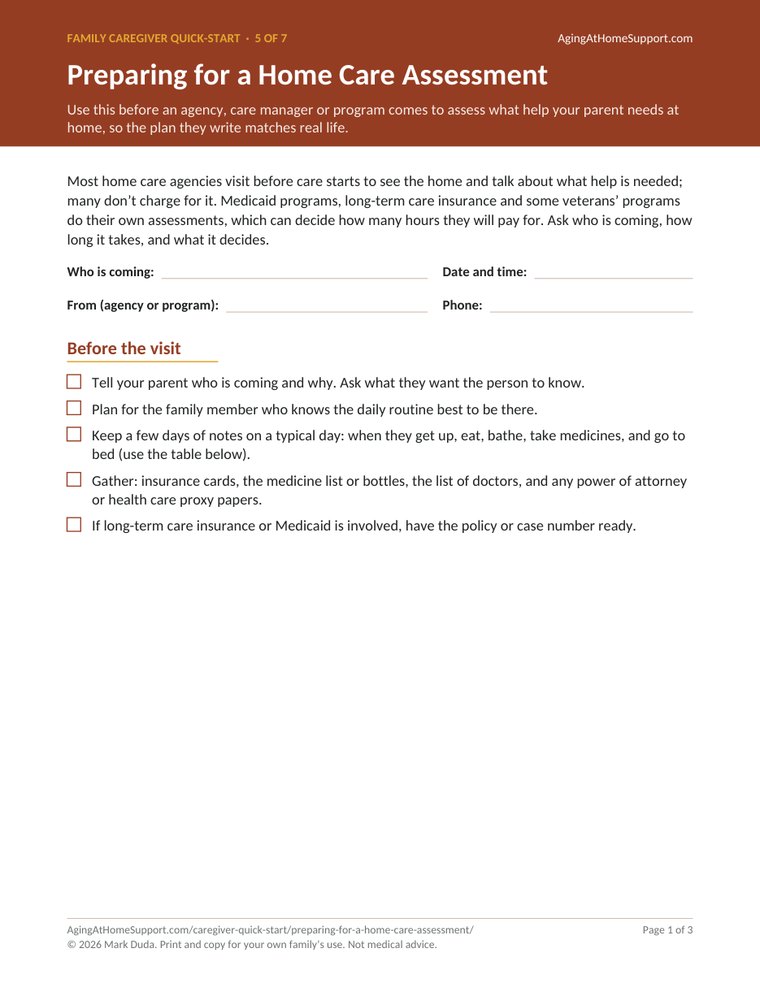
Before home care starts, someone usually comes to the house to see what help is needed: an agency nurse or care manager, or an assessor from Medicaid, long-term care insurance or a veterans’ program. What they write down can decide the plan, and sometimes how many hours are paid for. This checklist helps you make sure it matches real life.
The short version
- Ask who is coming, how long it takes, and what the assessment decides.
- Have the person who knows the daily routine best there.
- Write down a typical day, honestly, before the visit.
- Mention the bad days and the nights, not just how things look today.
Download the checklist
3 pages, ready to print on standard letter paper. Print it and write by hand, or type into it on a computer and save it.
Download the PDF →No cost. No email required.
Know someone who needs this?
Pass it along. It might be exactly what a family you know needs this week.
The checklist
Before the visit
- Tell your parent who is coming and why; ask what they want the person to know.
- Plan for the family member who knows the daily routine best to be there.
- Keep a few days of notes on a typical day.
- Gather insurance cards, the medicine list or bottles, the list of doctors, and any power of attorney or health care proxy papers.
- If long-term care insurance or Medicaid is involved, have the policy or case number ready.
A typical day: does it alone, needs some help, or needs a lot of help?
- Bathing or showering
- Dressing
- Using the toilet
- Getting in and out of bed or a chair
- Walking around the house
- Eating
- Taking medicines
- Cooking and meals
- Housekeeping and laundry
- Shopping and errands
- Managing money and bills
- Getting to appointments
During the visit
- Let your parent speak first; then add what you’ve seen, gently, with examples.
- Mention the bad days and the nights.
- Point out safety worries: falls, the stove, wandering, missed medicines.
- Ask what the plan will include, how many hours, and when it will be reviewed.
Questions to ask
- What did you find, and what do you recommend?
- How many hours a week, and what will the aide do on each visit?
- When will we see the written care plan?
- How do we change the plan if needs change?
- For insurance or Medicaid: how many hours are approved, and how do we appeal?
Why the “I manage fine” moment matters
Many parents present their best selves to a stranger. They may say they shower daily when it’s been a week, or that they cook when the meals are toast. That’s human, and it can lead to a plan with too little help. Agree with your parent beforehand that you’ll add what you’ve seen, and do it kindly and specifically: “Mom showers when I’m here on Sundays,” not “she never bathes.”
For a walk-through of what happens next, including the service agreement and the first shift, see how home care works.
Want the plan written down in one place?
The Family Care Plan is a fill-in workbook for families running a parent’s care: what she needs, who does what, what it costs, and what happens when something goes wrong. $14.99.
Questions families ask
What happens during a home care assessment?
A nurse, care manager or program assessor visits the home, talks with your parent and family about daily activities, health, medicines and safety, looks at the home, and recommends a plan of care, often including how many hours of help are needed.
Is a home care assessment free?
Many home care agencies don’t charge for the visit before care starts, but ask. Assessments by Medicaid programs, long-term care insurers or veterans’ programs are part of their own process and can decide what they will pay for.
How do I prepare a parent for a care assessment?
Tell them who is coming and why, ask what they want the assessor to know, have someone there who knows the daily routine, gather insurance cards, medicines and legal papers, and write down an honest picture of a typical day beforehand.
Your next step
Once care starts, Organizing a Parent’s Important Information helps everyone find what they need.
Go deeper
- How does home care work? What to expect
- The care needs checklist
- Home care planning guide
- Medicaid home care
- Long-term care insurance
The Family Caregiver Quick-Start
- Mom or Dad Can No Longer Live Alone: What to Do First
- Signs a Parent Needs More Help
- Preparing for a Family Care Meeting
- Choosing a Home Care Agency
- Preparing for a Home Care Assessment (this page)
- What to Bring to a Medical Appointment
- Organizing a Parent’s Important Information
See all seven, organized by where your family is, on the Family Caregiver Quick-Start page.
Changelog
- 24 November 2026 — Published with the printable checklist.
Sources
- Medicare.gov, “Long-term care” — Medicare doesn’t cover help with daily activities when that is the only care needed
Last verified: 24 November 2026 · Next review: May 2027
This page and checklist are educational and are not medical, legal or financial advice. Health questions belong with your parent’s doctor. Mark Duda is not a physician, nurse or attorney.
The checklists may be printed and copied for personal use within your own family.