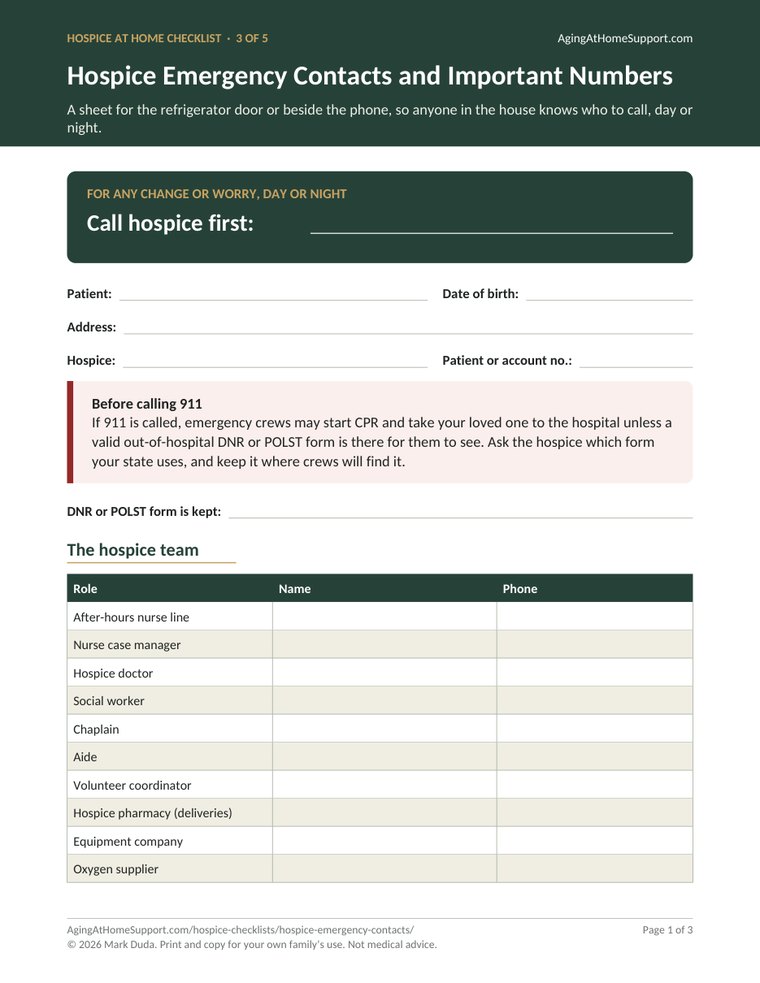
When someone is on hospice at home, everyone who helps needs to know one thing first: call the hospice, day or night. This sheet puts the hospice’s 24-hour number at the top, then the team, the family, where the DNR or POLST is kept, when to call, what to say, and a log of calls.
En español: Contactos de emergencia y números importantes del hospicio (lista para imprimir).
The short version
- Call hospice first for any change or worry. Put the number where anyone can see it.
- If 911 is called, crews may start CPR and take your loved one to the hospital unless a valid out-of-hospital DNR or POLST is there for them to see.
- Write down where the DNR or POLST is kept, and keep it where crews will find it.
- Keep a call log, so the next person on shift knows what was said.
Download the checklist
3 pages, ready to print on standard letter paper. Print it and write by hand, or type into it on a computer and save it.
Download the PDF →No cost. No email required.
Know someone who needs this?
Pass it along. It might be exactly what a family you know needs this week.
What’s on it
- Page 1: the 24-hour number, patient details, where the DNR or POLST is kept, and the hospice team
- Page 2: family and others, when to call the hospice, and when to call 911
- Page 3: what to say when you call, and a call log
How to use it
- Fill in page 1 with the nurse at the first visit.
- Put page 1 on the refrigerator and page 2 beside the phone.
- Show every helper and visitor where the sheet is, including anyone staying overnight.
Why “call hospice first” matters
In a frightening moment, 911 is the reflex. But for someone on hospice, the hospice team is usually the right first call: a nurse can talk you through what’s happening, change the medicines, or come to the house. If 911 is called, emergency crews are trained to start CPR and take the person to the hospital unless they see a valid out-of-hospital DNR order or POLST form. The rules and forms vary by state; ask the hospice which one your state uses. Our guide to POLST vs. advance directive explains the difference.
There are still times to call 911: a fire, someone else in the house who needs emergency help, or any situation the hospice team has told you to call 911 for.
Want every name, number and medicine in one place?
When Hospice Comes Home is an 18-page fill-in workbook for families caring for someone on hospice at home: the hospice team, who to call and what to say, comfort medications, a daily record for the nurse, and your rights. $14.99.
Questions families ask
Should I call 911 or hospice?
For changes in your loved one’s condition, call the hospice first, day or night. Call 911 for a fire, for anyone else who needs emergency help, or in situations the hospice team has told you to call 911 for.
What happens if 911 is called for a hospice patient?
Emergency crews may start CPR and take the person to the hospital unless a valid out-of-hospital DNR order or POLST form is there for them to see. Keep the form where crews will find it, and ask the hospice about your state’s form.
What should I say when I call the hospice?
Give your name and the patient’s name, what is happening and when it started, anything you have already tried including any medicine given and the time, and your phone number in case the call drops.
The rest of this set
- Preparing for the First Hospice Visit: what to have ready, who should be there, and what to confirm before the nurse leaves
- Questions to Ask the Hospice Team: 15 questions about visits, nights, comfort, medicines, your family’s role and support
- Preparing the Home for Hospice Care: the room, the bed and equipment, a supply station, comfort, and a household plan
- Understanding Hospice Medications and Equipment: what each medicine and piece of equipment is for, questions to ask, and a dose log
All five are on the hospice at home checklists page.
Related reading on this site
- POLST vs. advance directive
- Emergency Information Sheet: a printable for the refrigerator door
- Hospice care at home: what actually shows up
- What is comfort care? What it means when a doctor says it
Changelog
- 24 November 2026 — Published with the printable checklist.
Sources
- Medicare.gov, “Hospice care” — what hospice covers, the up-to-$5 prescription copayment and respite care
- National POLST — what a POLST form is and how it works with emergency crews
Last verified: 24 November 2026 against Medicare.gov and National POLST · Next review: May 2027, or when the rules change
This page and checklist are educational and are not medical advice. The hospice team manages your loved one’s care; call them with any question about symptoms, medicines or equipment. Mark Duda is not a physician, nurse or attorney.
The checklists may be printed and copied for personal use within your own family.