Once hospice care is chosen, a hospice nurse comes to the home for the first visit, usually within 48 hours and often sooner. This checklist helps your family get ready: the papers and medicines to have out, who should be there, a few things to think about ahead of time, and what to confirm before the nurse leaves.
The short version
- You don’t have to have everything ready. The nurse will help with what’s missing.
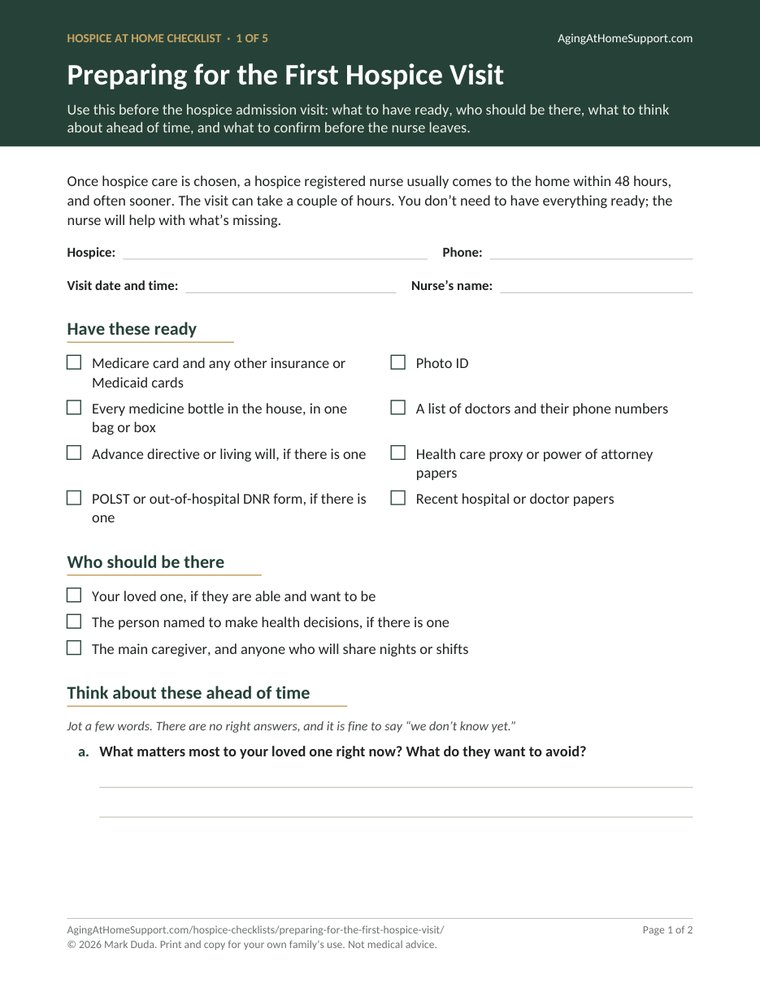
- Have out: insurance cards, every medicine bottle, the list of doctors, and any advance directive, health care proxy or POLST.
- Have the decision-maker and the main caregiver there, and your loved one if they are able and want to be.
- Before the nurse leaves, post the 24-hour number and know when to call the hospice first.
Download the checklist
2 pages, ready to print on standard letter paper. Print it and write by hand, or type into it on a computer and save it.
Download the PDF →No cost. No email required.
Know someone who needs this?
Pass it along. It might be exactly what a family you know needs this week.
What’s on it
- Have these ready: eight papers and items
- Who should be there
- Think about these ahead of time: what matters most, the symptoms that worry you, what the family can and can’t do, spiritual support
- Before the nurse leaves: six things to confirm, starting with the 24-hour number
How to use it
- Print it as soon as the visit is scheduled.
- Gather the papers and medicines into one bag or box the night before.
- Jot a few words for each question in the “think about” section. “We don’t know yet” is a fine answer.
- Go through the last section with the nurse before they leave.
What usually happens at the first visit
Under Medicare rules, a hospice registered nurse completes an initial assessment within 48 hours after hospice care is elected, unless the patient, representative or doctor asks for it sooner. The visit often takes a couple of hours: the nurse talks with your loved one and the family, reviews symptoms and medicines, explains the consent forms, orders equipment and supplies, and leaves the number to call day or night. The full team, including the doctor, nurse, social worker and chaplain, then completes a fuller assessment within the first several days.
Every hospice does this a little differently. Ask the nurse what the first week will look like.
Want every name, number and medicine in one place?
When Hospice Comes Home is an 18-page fill-in workbook for families caring for someone on hospice at home: the hospice team, who to call and what to say, comfort medications, a daily record for the nurse, and your rights. $14.99.
Questions families ask
What happens at the first hospice visit?
A hospice registered nurse visits to assess your loved one’s needs, review symptoms and medicines, explain and sign the consent forms, order equipment and supplies, and set up the plan for the first days. Before leaving, the nurse should give you the hospice’s 24-hour number.
How soon does hospice come after you sign up?
Medicare rules require the hospice registered nurse to complete the initial assessment within 48 hours after hospice care is elected, and sooner if the patient, representative or doctor asks.
What papers do we need for the hospice admission visit?
Medicare and other insurance cards, a photo ID, every medicine bottle, a list of doctors, and any advance directive, health care proxy or power of attorney, and POLST or out-of-hospital DNR form. Don’t worry if something is missing; the nurse will help.
The rest of this set
- Questions to Ask the Hospice Team: 15 questions about visits, nights, comfort, medicines, your family’s role and support
- Hospice Emergency Contacts and Important Numbers: a refrigerator sheet with the 24-hour number, the team, when to call and a call log
- Preparing the Home for Hospice Care: the room, the bed and equipment, a supply station, comfort, and a household plan
- Understanding Hospice Medications and Equipment: what each medicine and piece of equipment is for, questions to ask, and a dose log
All five are on the hospice at home checklists page.
Related reading on this site
- Hospice care at home: what actually shows up
- How to choose a quality hospice (and spot the warning signs)
- What is comfort care? What it means when a doctor says it
- Palliative care vs. hospice: what actually changes
- POLST vs. advance directive
Changelog
- 24 November 2026 — Published with the printable checklist.
Sources
- 42 CFR 418.54, hospice initial and comprehensive assessment — the registered nurse’s initial assessment within 48 hours of the election of hospice care
- Medicare.gov, “Hospice care” — what hospice covers, the up-to-$5 prescription copayment and respite care
Last verified: 24 November 2026 against 42 CFR 418.54 and Medicare.gov · Next review: May 2027, or when the rules change
This page and checklist are educational and are not medical advice. The hospice team manages your loved one’s care; call them with any question about symptoms, medicines or equipment. Mark Duda is not a physician, nurse or attorney.
The checklists may be printed and copied for personal use within your own family.