Hospice at home usually brings a hospital bed, other equipment and a steady flow of visitors. This checklist helps your family set up a room that is safe and comfortable, keep supplies in one place, and agree on who handles what, so the hospice team and the family can focus on care.
The short version
- Start with where your loved one wants to be, then check the space around the bed and the path to the bathroom.
- Agree on where the bed goes before it’s delivered.
- Oxygen in the house means no smoking, candles or open flames.
- Ask about respite care. The caregiver needs rest too.
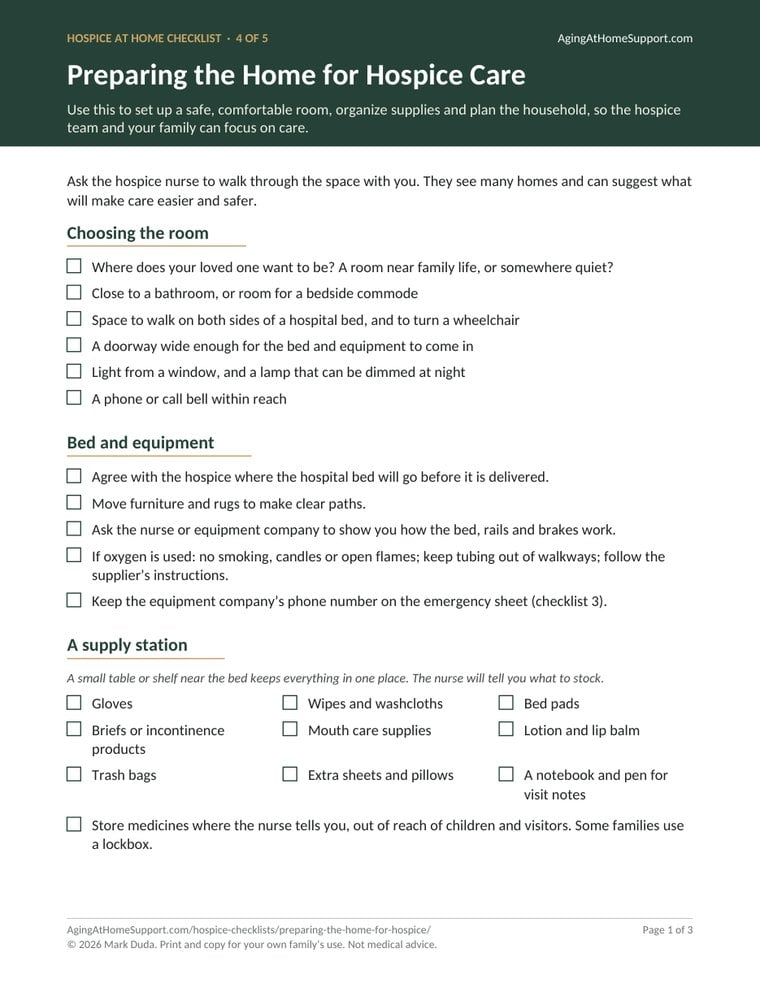
Download the checklist
3 pages, ready to print on standard letter paper. Print it and write by hand, or type into it on a computer and save it.
Download the PDF →No cost. No email required.
Know someone who needs this?
Pass it along. It might be exactly what a family you know needs this week.
What’s on it
- Choosing the room: six things to consider
- Bed and equipment, including oxygen safety
- A supply station: what to keep by the bed, and storing medicines safely
- Comfort: familiar things, light, sound and visitors
- The household plan: visits, nights, meals, updates, pets and bills, and rest for the caregiver
How to use it
- Walk the space with the hospice nurse if you can. They see many homes.
- Fill in the household plan as a family, one name per job.
- Revisit it after the first week. Needs change.
Choosing the room
There’s no single right room. Some people want to be in the middle of family life, in the living room with the noise and the dog; others want quiet. What matters most is what your loved one wants, then the practical things: space to walk on both sides of a hospital bed, a doorway wide enough to bring it in, a bathroom or room for a commode nearby, and a phone or bell within reach. Ask the hospice nurse to look at the space with you before the equipment arrives.
Medicare hospice covers equipment and supplies related to the illness, such as a hospital bed, wheelchair, oxygen and incontinence supplies. Our guide to hospice care at home lists what typically comes.
Want every name, number and medicine in one place?
When Hospice Comes Home is an 18-page fill-in workbook for families caring for someone on hospice at home: the hospice team, who to call and what to say, comfort medications, a daily record for the nurse, and your rights. $14.99.
Questions families ask
How do I set up a room for hospice at home?
Choose a room where your loved one wants to be, with space on both sides of a hospital bed, a wide enough doorway, a nearby bathroom or room for a commode, and a phone or bell within reach. Agree on where the bed will go before delivery, clear paths, set up a supply station by the bed, and add familiar things for comfort.
What equipment does hospice provide?
Under Medicare, hospice covers medical equipment and supplies related to the terminal illness, such as a hospital bed, wheelchair or walker, bedside commode, oxygen, and incontinence and wound supplies. Ask your hospice what it will provide.
Can the caregiver get a break during hospice?
Yes. Medicare’s hospice benefit includes respite care: a short inpatient stay, up to five days at a time, so the caregiver can rest. Ask the hospice social worker about it, and about other help with caregiving.
The rest of this set
- Preparing for the First Hospice Visit: what to have ready, who should be there, and what to confirm before the nurse leaves
- Questions to Ask the Hospice Team: 15 questions about visits, nights, comfort, medicines, your family’s role and support
- Hospice Emergency Contacts and Important Numbers: a refrigerator sheet with the 24-hour number, the team, when to call and a call log
- Understanding Hospice Medications and Equipment: what each medicine and piece of equipment is for, questions to ask, and a dose log
All five are on the hospice at home checklists page.
Related reading on this site
- Hospice care at home: what actually shows up
- Home Safety Checklist: a room-by-room walk-through
- Respite care
- Caregiver burnout
- Fall prevention at home
Changelog
- 24 November 2026 — Published with the printable checklist.
Sources
- Medicare.gov, “Hospice care” — what hospice covers, the up-to-$5 prescription copayment and respite care
- 42 CFR 418.106, hospice drugs, supplies and equipment — written policies on the safe use and disposal of controlled drugs, discussed with the family
Last verified: 24 November 2026 against Medicare.gov and 42 CFR 418.106 · Next review: May 2027, or when the rules change
This page and checklist are educational and are not medical advice. The hospice team manages your loved one’s care; call them with any question about symptoms, medicines or equipment. Mark Duda is not a physician, nurse or attorney.
The checklists may be printed and copied for personal use within your own family.