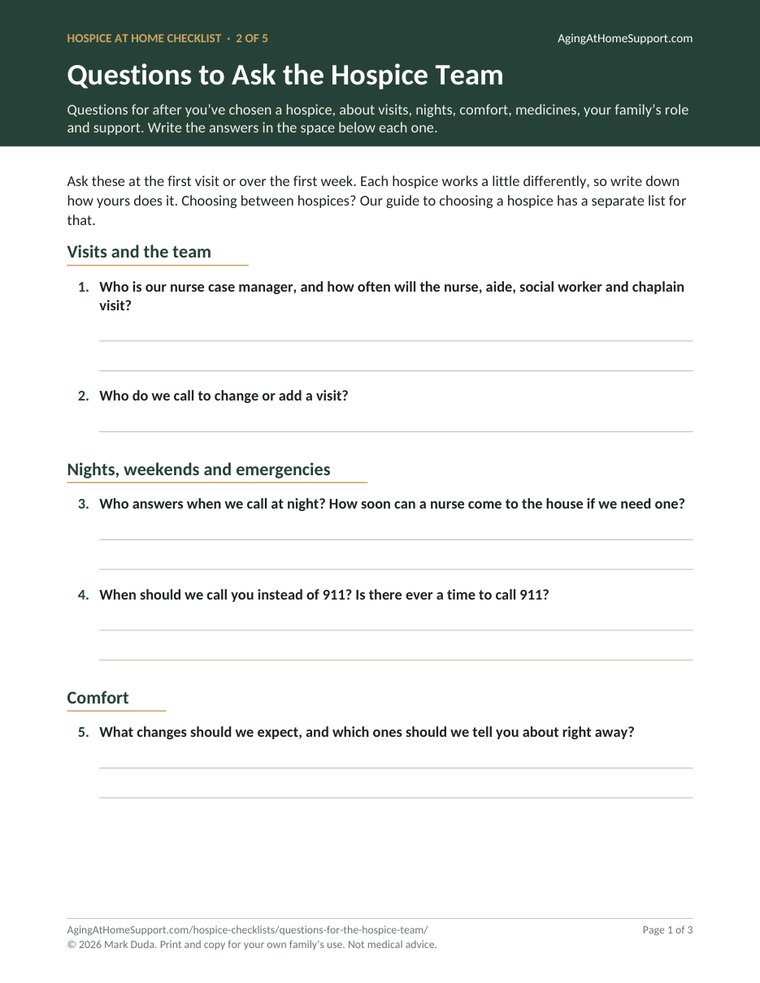
Once hospice has started, these are the questions to ask the team: fifteen of them, with room for the answers. They cover visits, nights and emergencies, comfort, medicines and equipment, what the family is expected to do, and the support available to you, including when death comes.
The short version
- This list is for after you’ve chosen a hospice. Comparing hospices? Our guide to choosing a hospice has its own list.
- Ask who answers at night and how soon a nurse can come.
- Ask what the family is expected to do, and whether they will show you and write it down.
- Ask about respite and bereavement support. They are part of the Medicare hospice benefit.
Download the checklist
3 pages, ready to print on standard letter paper. Print it and write by hand, or type into it on a computer and save it.
Download the PDF →No cost. No email required.
Know someone who needs this?
Pass it along. It might be exactly what a family you know needs this week.
What’s on it
- Visits and the team (questions 1–2)
- Nights, weekends and emergencies (3–4)
- Comfort, including continuous home care in a crisis (5–7)
- Medicines, supplies and equipment, including the comfort kit (8–10)
- Our family’s role (11–12)
- Support: respite, family support and what happens at the time of death (13–15)
How to use it
- Bring it to the first visit and keep it with the hospice folder.
- You don’t have to ask everything at once. Most families cover it over the first week.
- Write down how your hospice does it, since each one works a little differently.
What the Medicare hospice benefit includes
Under Medicare, hospice covers the care team, medicines and equipment for pain and symptoms related to the illness, and four levels of care, including continuous care at home during a crisis and short inpatient stays when symptoms can’t be managed at home. It also includes respite care: a short inpatient stay, up to five days at a time, so the caregiver can rest. Hospices must offer bereavement support to the family for up to a year after the death. Our guide to hospice care at home explains each one.
Hospice does not usually provide someone in the home around the clock. Between visits, the family does much of the day-to-day care, with the team on call. Question 11 is the one to ask plainly, and question 12 is the one families often wish they had asked sooner.
Want every name, number and medicine in one place?
When Hospice Comes Home is an 18-page fill-in workbook for families caring for someone on hospice at home: the hospice team, who to call and what to say, comfort medications, a daily record for the nurse, and your rights. $14.99.
Questions families ask
What should I ask the hospice team?
Ask who your nurse case manager is and how often each team member will visit, who answers at night and how soon a nurse can come, when to call the hospice instead of 911, how quickly medicines can change if symptoms get worse, what the family is expected to do, how respite care works, what support is available for the family, and what to do when death comes.
Does hospice provide care 24 hours a day?
A hospice nurse is available by phone 24 hours a day, and the hospice must be able to send a nurse when needed. Routine hospice care is visits, not someone in the home around the clock, but during a medical crisis Medicare covers continuous home care for short periods.
What is hospice respite care?
Respite care is a short inpatient stay, up to five days at a time, in a Medicare-approved facility so the family caregiver can rest. Under Medicare you may pay 5% of the Medicare-approved amount.
The rest of this set
- Preparing for the First Hospice Visit: what to have ready, who should be there, and what to confirm before the nurse leaves
- Hospice Emergency Contacts and Important Numbers: a refrigerator sheet with the 24-hour number, the team, when to call and a call log
- Preparing the Home for Hospice Care: the room, the bed and equipment, a supply station, comfort, and a household plan
- Understanding Hospice Medications and Equipment: what each medicine and piece of equipment is for, questions to ask, and a dose log
All five are on the hospice at home checklists page.
Related reading on this site
- Hospice care at home: what actually shows up
- How to choose a quality hospice (and spot the warning signs)
- Respite care
- What is comfort care? What it means when a doctor says it
- Caregiver burnout
Changelog
- 24 November 2026 — Published with the printable checklist.
Sources
- Medicare.gov, “Hospice care” — what hospice covers, the up-to-$5 prescription copayment and respite care
- 42 CFR 418.64, hospice core services — bereavement services offered to the family for up to one year after the death
- 42 CFR 418.400, hospice coinsurance — the drug copayment of no more than $5 per prescription and respite coinsurance
Last verified: 24 November 2026 against Medicare.gov and 42 CFR 418.64 and 418.400 · Next review: May 2027, or when the rules change
This page and checklist are educational and are not medical advice. The hospice team manages your loved one’s care; call them with any question about symptoms, medicines or equipment. Mark Duda is not a physician, nurse or attorney.
The checklists may be printed and copied for personal use within your own family.